
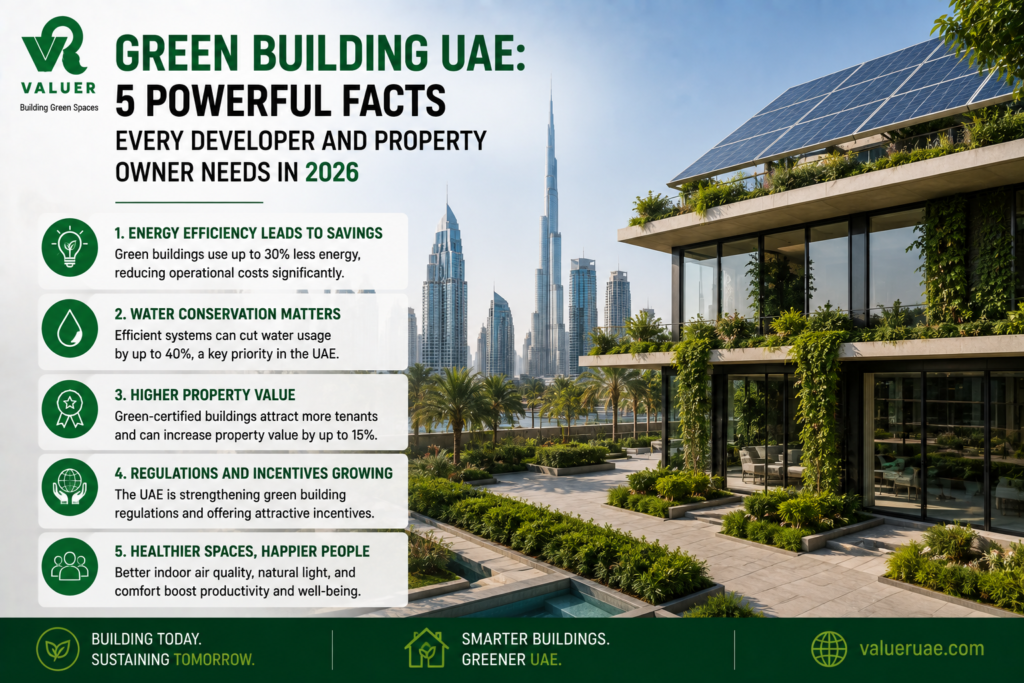
Green building UAE is no longer a niche category for sustainability-conscious developers — it is the defining standard of the UAE’s construction and property market in 2026. The future of green building UAE is no longer a long-term vision — it is an active transformation already reshaping the construction, real estate, and investment landscape as the country accelerates toward its Net Zero 2050 goals, with green buildings evolving from premium projects into a market-wide standard. ERKE
The UAE’s sustainable building materials market alone is valued at USD 1.2 billion — a reflection of the regulatory momentum and investor demand that has made green building UAE one of the most commercially significant trends across the region’s real estate and construction sectors in 2026. Yasutrading
Whether you are a developer planning a new project, a property owner planning renovation works, or a facilities manager responsible for an existing commercial or residential asset — understanding the five most important facts about green building UAE is essential for making informed decisions that align with both regulatory requirements and commercial opportunities in 2026.
Fact 1 — Green Building UAE Is Growing at 15.62% Annually
The UAE Green Building Material Market is growing at a CAGR of 15.62% during 2026 to 2032 — one of the fastest growth rates of any construction materials category across the entire GCC region, driven by large-scale sustainable construction initiatives and green building regulations embedded in project approval processes across Dubai, Abu Dhabi, and the wider UAE. MarkNtel Advisors
This growth rate is not driven by voluntary industry enthusiasm — it is driven by a regulatory framework that increasingly leaves developers and property owners with no viable path through the project approval process that does not engage with green building UAE requirements. Understanding this regulatory trajectory is the most important commercial context for any developer or property owner making material and specification decisions in 2026.
Fact 2 — Dubai’s Al Sa’fat and Abu Dhabi’s Estidama Are Now Baseline Requirements
The two most important green building UAE frameworks — Dubai’s Al Sa’fat Green Building Rating System and Abu Dhabi’s Estidama Pearl Rating System — have moved from aspirational standards to baseline compliance requirements for most categories of new construction across their respective emirates.
Sustainable building codes such as the Estidama Pearl Rating System and Dubai Green Building Regulations encourage or require solar integration and high-performance glazing in new developments — with green building UAE certification increasingly a prerequisite for project approval rather than a voluntary differentiator for developers seeking premium positioning. Heptagonproperties
For property owners and developers, the practical consequence of these frameworks is a defined minimum specification list that includes thermally broken aluminium window and door systems, double glazed Low-E glass units, high-performance insulation meeting defined U-value thresholds, and low-VOC interior materials — all of which must be specified and documented before building permit approval is granted across the majority of new construction and significant renovation projects in the UAE.
Fact 3 — Green Building UAE Commands Measurable Financial Premiums
Beyond regulatory compliance, green building UAE credentials are now generating measurable financial returns in the property transaction market — with LEED, Al Sa’fat, and Estidama certified buildings consistently achieving rental and sale price premiums over equivalent non-certified properties in the UAE’s increasingly sophisticated investment property market.
Projects built with sustainable building materials are more aligned with long-term regulatory and market expectations — with green building UAE credentials increasingly factored into institutional tenant lease negotiations, sustainability-linked financing arrangements, and ESG investment fund eligibility assessments across the UAE’s commercial property sector. Ducongreen
For residential property owners, the green building UAE premium is equally real — with energy-efficient windows, sustainable outdoor materials, and green certification credentials all commanding measurable rental rate advantages in a 2026 market where tenants are increasingly literate about the relationship between building specification quality and their monthly utility bills.
Fact 4 — Lifecycle Cost Makes Green Building UAE the Financially Smarter Choice
The most successful developers in 2026 are shifting from short-term budgeting to lifecycle thinking — with total lifecycle value becoming the smarter metric for green building UAE investment decisions, as projects built to green standards consistently outperform conventional construction across 20 to 30 year ownership horizons. Ducongreen
The lifecycle cost calculation for green building UAE investments typically covers three distinct financial benefits — reduced operational energy costs from high-performance building envelopes and glazing systems, lower maintenance costs from durable, weather-resistant sustainable materials, and higher terminal property value at eventual sale or lease renewal from the market premium that certified green building UAE assets command over non-certified equivalents.
When these three financial streams are modelled across a realistic 20-year ownership horizon, green building UAE investments consistently demonstrate positive net present value even when upfront construction cost premiums of 10 to 20% are applied to the base case — making the business case for green building UAE specification not just ethically sound but financially compelling.
Fact 5 — WPC, Aluminium, and Recycled Steel Are the Core Green Building UAE Materials
For the specific range of products and installations that property developers and owners actually procure — as opposed to the broader conceptual category of green building — three material categories dominate the practical green building UAE landscape: WPC composites, thermally broken aluminium systems, and recycled and galvanized steel fabrication.
Locally manufactured galvanized steel products improve sustainability by offering durability, recyclability, and reduced transportation emissions — with UAE-manufactured galvanized steel products meeting full engineering specification while supporting the local supply chain development that green building UAE frameworks increasingly reward in their rating point systems. GTI
WPC composite decking, wall cladding, and flooring contribute to green building UAE credentials through their recycled content, chemical-free operation, and exceptional longevity that reduces material replacement cycles across the building’s operational life. Thermally broken aluminium windows, doors, and facade systems contribute through their measurable reduction in cooling energy demand that directly improves the building’s operational carbon footprint. Galvanized and powder-coated steel fabrication for gates, fencing, pergolas, and shade structures contributes through material recyclability and the durability that reduces replacement material demand across the structure’s lifetime.
UAE landmarks demonstrate what green building UAE can achieve at scale — with the Al Bahr Towers’ smart shading system reducing air conditioning need by nearly 50%, and Masdar City operating on renewable energy with recycled water and zero-carbon mobility — setting the benchmark that the UAE’s regulatory framework is progressively moving the broader market toward across all property categories. Kotook
According to Dubai Municipality, all construction projects must comply with applicable green building regulations and energy performance standards — Valuer UAE supplies and installs the WPC, aluminium, and steel products that form the core of any UAE property’s green building compliance strategy.
Explore: Green Building Solutions — Valuer UAE
FAQs — Green Building UAE
What is green building UAE and why does it matter?
Green building UAE refers to construction and renovation projects that comply with UAE sustainability frameworks including Al Sa’fat and Estidama — specifying energy-efficient materials, high-performance glazing, and sustainable building products that reduce operational carbon emissions, lower utility bills, and meet increasingly mandatory regulatory requirements across the UAE’s construction and property sectors.
Is green building UAE certification required for all new construction?
Al Sa’fat compliance is effectively mandatory for most new construction in Dubai — with project approval processes requiring documentation of green building performance across glazing, insulation, and building envelope specifications. Estidama Pearl rating requirements apply to Abu Dhabi projects with equivalent mandatory compliance thresholds.
What are the financial benefits of green building UAE certification?
Green building UAE certified properties command measurable rental and sale price premiums over equivalent non-certified assets, achieve lower operational energy costs through reduced DEWA bills, attract sustainability-linked financing at preferential rates, and qualify for ESG investment fund portfolios — creating multiple simultaneous financial return streams beyond the compliance value of certification.
Which materials contribute most to green building UAE compliance?
Thermally broken aluminium glazing systems, WPC composite decking and cladding, Low-E double glazed glass, high-performance insulation, and recycled steel structural products are the most impactful material categories for achieving green building UAE compliance across residential, commercial, and mixed-use development projects.
How can Valuer UAE support my green building UAE project?
Contact Valuer UAE via our enquiry form, email hello@valueruae.com, or WhatsApp +971 52 653 4567 for a fast, itemised quote on WPC products, aluminium systems, and steel fabrication works that contribute directly to green building UAE compliance across your project.