
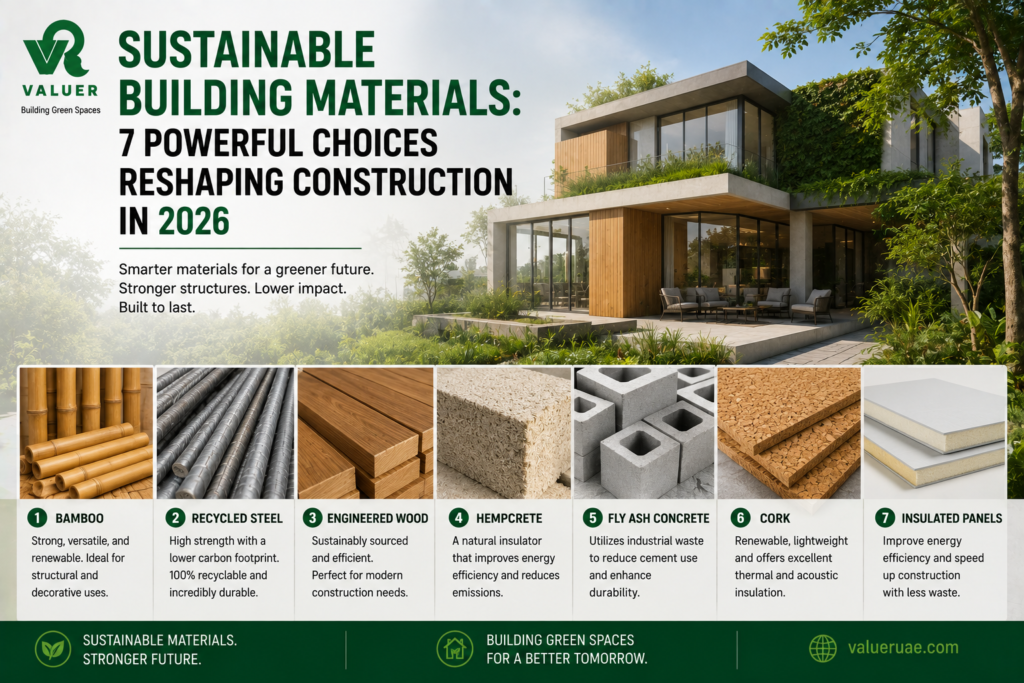
Sustainable building materials have crossed the line from premium choice to market standard in 2026. The UAE’s sustainable building materials market is already valued at USD 1.2 billion — a significant slice of the GCC’s wider USD 10.6 billion green sector — being driven by regulations like Dubai’s Green Building Regulations baked into the approval process for nearly all new construction. Yasutrading
In 2026, carbon efficiency is influencing procurement decisions just as much as price and performance — with the most successful developers shifting from short-term budgeting to lifecycle thinking, where total value over a building’s operational life is the smarter metric than upfront cost alone. Ducongreen
For property developers, contractors, facilities managers, and homeowners across the UAE, understanding which sustainable building materials deliver genuine performance alongside their environmental credentials is now an operational and regulatory priority — not a philosophical preference.
Why Sustainable Building Materials Are No Longer Optional
The UAE Green Building Material Market is projected to grow at a CAGR of 15.62% during 2026 to 2032 — driven by large-scale sustainable construction initiatives and green building regulations that effectively mandate sustainable material choices across most categories of new construction across the emirate. MarkNtel Advisors
Sustainable building materials transform construction practices by reducing environmental impact while meeting modern building standards — lowering carbon emissions, conserving resources, and improving energy efficiency in hot climates, with government initiatives driving their adoption across UAE construction projects. GTI
The practical consequence for anyone building, renovating, or managing property in the UAE in 2026 is straightforward — sustainable building materials are no longer a differentiator for premium projects. They are the baseline expectation of regulators, sophisticated buyers, and international tenants across every tier of the UAE property market.
Material 1 — Wood-Plastic Composite (WPC)
WPC is among the most practically significant sustainable building materials for residential and commercial property applications in the UAE — combining recycled wood fibre and recycled plastic into a composite product that eliminates both the virgin timber demand and the chemical treatment requirements associated with conventional timber decking, cladding, and flooring.
WPC sustainable building materials are used across pool decks, garden terraces, balconies, feature walls, and indoor flooring across the UAE — delivering the natural warmth of timber aesthetics with a 25 to 30 year operational lifespan that dramatically outperforms the 10 to 15 years achievable with timber in Gulf climate conditions. The elimination of annual staining, sealing, and chemical treatment requirements reduces both maintenance cost and environmental impact across the full product lifetime — making WPC sustainable building materials a genuinely compelling choice for any UAE property owner prioritising both performance and environmental responsibility.
Material 2 — Thermally Broken Aluminium Systems
Thermally broken aluminium window, door, and facade systems are among the most impactful sustainable building materials available to UAE property developers and homeowners — with their ability to reduce cooling energy consumption by 20 to 30% making them one of the single most effective interventions for reducing the operational carbon footprint of any residential or commercial building across the region.
Ventilated doors and windows that optimise airflow and insulation alongside thermal insulation systems significantly reduce heat loss and boost overall building energy efficiency — with thermally broken aluminium systems combining structural performance with the energy efficiency credentials required for Al Sa’fat and Estidama green building certification across UAE construction projects. MIR Green Buildings
Aluminium’s 100% recyclability at end of life further strengthens its credentials as one of the most sustainable building materials for structural and envelope applications — with recycled aluminium production requiring just 5% of the energy required to produce virgin aluminium from bauxite ore.
Material 3 — Recycled Steel
Recycled steel cuts energy use by 75% compared to virgin production — with scrap metal processing requiring less mining and transportation than new ore extraction, and UAE recycling facilities processing construction steel waste into high-quality rebar and structural sections that meet full engineering specification requirements. GTI
The recycled steel category will have the highest CAGR of 9.3% among all sustainable building materials in the UAE through 2030 — driven by the construction industry’s transition toward circular economy principles embedded in the UAE’s Circular Economy Policy 2021 to 2031 which prioritises renovation, better material use, and recycling targets. P&S Intelligence
For structural gate fabrication, fencing systems, pergola frames, car parking shade structures, and architectural metalwork — all core applications across Valuer UAE’s technical services — recycled and responsibly sourced steel represents the most technically capable and environmentally appropriate structural material choice available across the UAE’s construction market in 2026.
Material 4 — Low-E Double Glazed Glass
Low-emissivity double glazed glass units are among the most consequential sustainable building materials for the UAE’s built environment — with their ability to reduce solar heat gain, cut cooling energy demand, and block UV radiation making them a direct enabler of the energy performance standards required under Al Sa’fat and Estidama green building frameworks.
Sustainable building codes such as the Estidama Pearl Rating System and Dubai Green Building Regulations encourage or require solar integration and high-performance glazing in new developments — making Low-E double glazed glass sustainable building materials a baseline specification requirement rather than a premium upgrade for most new UAE construction. Heptagonproperties
Every kilowatt hour of cooling energy avoided through correctly specified glazing in a UAE building reduces both the occupant’s DEWA bill and the building’s operational carbon footprint simultaneously — making Low-E double glazed glass one of the few sustainable building materials that deliver measurable financial and environmental returns from the day of installation.
Material 5 — Sustainably Sourced Timber
Sustainable wood sourced from certified forests provides excellent thermal properties while reducing embodied carbon compared to conventional construction materials — with its adaptability across multiple applications including framing, interior finishing, and exterior siding making it the preferred choice for developers seeking to balance sustainability with construction efficiency across UAE projects. P&S Intelligence
For interior applications, architectural elements, and decorative works, FSC-certified sustainably sourced timber delivers the irreplaceable natural warmth and material character that engineered alternatives approach but cannot fully replicate — while providing the environmental credentials required for green building certification across residential and commercial projects in the UAE.
Material 6 — High-Performance Insulation
The insulation materials segment dominates the UAE Green Building Material market with around 32% market share — reflecting their central role in meeting energy efficiency and sustainability requirements embedded in local building codes across the emirate. MarkNtel Advisors
High-performance mineral wool, rock wool, and aerogel insulation systems applied to roofs, walls, and floors reduce the cooling load on air conditioning systems — the single largest contributor to operational carbon emissions across UAE buildings — by preventing heat transfer through the building envelope at the source rather than relying on mechanical cooling to compensate for inadequate thermal resistance.
Material 7 — Powder-Coated Aluminium Cladding
Powder-coated aluminium cladding systems represent one of the most durable, low-maintenance, and recyclable sustainable building materials for UAE building facades and exterior applications — combining a 15 to 20 year colour and corrosion warranty with 100% material recyclability at end of life and zero VOC emission during the operational life of the installation.
Modern sustainable building materials in the UAE now meet strict technical and quality standards — with developers no longer needing to choose between sustainability and performance, as the two have converged into a single specification category across the UAE’s maturing green construction market. Ducongreen
According to Dubai Municipality, all construction and renovation projects must comply with applicable green building regulations and material performance standards — Valuer UAE ensures full compliance on every installation delivered across the UAE.
Explore: Sustainable Building Solutions — Valuer UAE
FAQs — Sustainable Building Materials
What are the most widely used sustainable building materials in UAE construction?
The most widely used sustainable building materials in UAE construction are thermally broken aluminium glazing systems, WPC composite decking and cladding, recycled steel structural elements, Low-E double glazed glass, high-performance insulation, sustainably sourced timber, and powder-coated aluminium facade systems — all of which are now embedded in UAE green building regulation frameworks.
Are sustainable building materials more expensive than conventional alternatives?
Upfront costs for sustainable building materials are typically 10 to 30% higher than conventional alternatives — but lifecycle cost analysis consistently demonstrates lower total ownership costs through reduced energy bills, lower maintenance requirements, and longer operational lifespans that make sustainable building materials the financially smarter choice over any realistic project timelin
Which sustainable building materials are required by Dubai’s Al Sa’fat regulations?
Al Sa’fat regulations require thermally broken aluminium frames with double glazed Low-E units for most commercial and large-scale residential window applications, high-performance insulation meeting defined U-value thresholds, and building envelope materials meeting specified solar heat gain and thermal performance standards.
Do sustainable building materials perform as well as conventional alternatives in the UAE?
Yes. As research confirms, modern sustainable building materials meet strict technical and quality standards in the UAE — with developers no longer required to choose between sustainability and performance, as advanced manufacturing processes have converged both attributes into single specification categories across the market.
How can Valuer UAE support my sustainable building project?
Contact Valuer UAE via our enquiry form, email hello@valueruae.com, or WhatsApp +971 52 653 4567 for a fast, itemised quote on WPC products, aluminium systems, and fabrication works for sustainable construction projects across the UAE.