
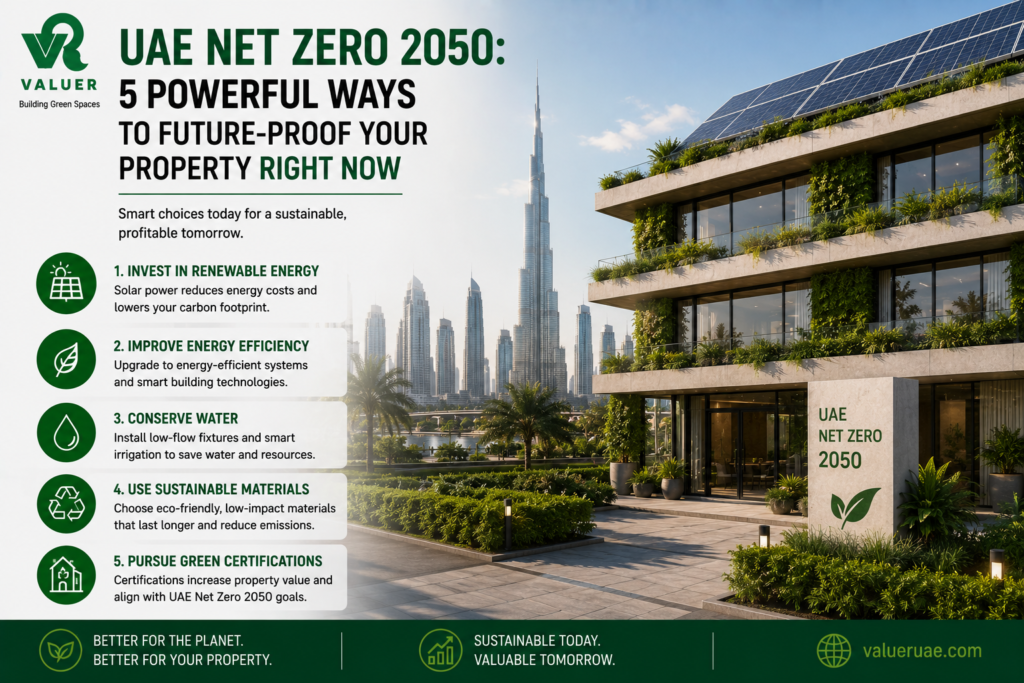
UAE Net Zero 2050 is not a distant policy ambition — it is an active regulatory and market force reshaping every decision in the UAE’s construction, property, and facilities management sectors right now in 2026. As the UAE accelerates toward its Net Zero 2050 goals, green buildings are evolving from premium projects into a market-wide standard — with the transformation already reshaping the construction, real estate, and investment landscape across the entire region. ERKE
For property owners, developers, and facilities managers across the UAE, the UAE Net Zero 2050 strategic initiative creates both obligation and opportunity — obligation because the regulatory frameworks supporting this target are progressively tightening the performance standards required for new construction and renovation approvals, and opportunity because properties that align proactively with UAE Net Zero 2050 goals consistently command financial premiums in the market that reward early movers over late adopters.
This guide gives you the five most practical, high-impact actions you can take right now to align your property with UAE Net Zero 2050 — with real cost context, genuine financial return projections, and direct relevance to the specific materials and installations available across the UAE market today.
Why UAE Net Zero 2050 Matters for Individual Property Owners Right Now
The most common misconception about UAE Net Zero 2050 is that it is a concern only for governments, major developers, and large corporations — and that individual homeowners, small landlords, and mid-sized commercial property operators do not need to engage with it until some future regulatory inflection point forces them to.
This misconception is becoming increasingly expensive. The UAE Net Zero 2050 regulatory framework is already embedded in Dubai’s Al Sa’fat system, Abu Dhabi’s Estidama rating, and DEWA’s tiered pricing structure — meaning individual property owners are already financially affected by UAE Net Zero 2050 through the energy pricing signals that progressively increase the cost of inefficient energy consumption across all residential and commercial properties.
Sustainability has moved from a nice-to-have to a non-negotiable legal requirement in the UAE — with UAE Net Zero 2050 driving regulation that is baked into the approval process for nearly all new construction and increasingly referenced in renovation permit requirements across the emirate. Yasutrading
Action 1 — Upgrade to High-Performance Glazing Systems
The single most impactful action any UAE property owner can take to align with UAE Net Zero 2050 goals is replacing standard single-pane or un-broken aluminium window systems with thermally broken aluminium frames and double glazed Low-E units — directly reducing the building’s cooling energy demand, which is the largest single contributor to residential and commercial operational carbon emissions across the UAE.
Air conditioning accounts for up to 60% of UAE household electricity consumption — and UAE Net Zero 2050 cannot be achieved at the national level without dramatic improvements in the efficiency of the cooling energy demand that the UAE’s building stock generates. High-performance glazing is the most direct individual property-level contribution to this national target.
Thermally broken aluminium windows with double glazing and Low-E coating reduce cooling energy consumption by 20 to 30% — delivering a payback period of 3 to 7 years against installation cost, with 20 or more years of energy savings beyond payback fully aligned with both individual financial interest and UAE Net Zero 2050 national goals.
Action 2 — Specify WPC Composite Materials for Outdoor and Cladding Applications
WPC composite products — decking, flooring, and wall cladding — contribute to UAE Net Zero 2050 alignment through three distinct sustainability channels that make them among the most practically impactful material choices for residential and commercial property owners across the region.
First, WPC products are manufactured using recycled post-consumer plastic as a primary feedstock — directly diverting plastic waste from landfill and reducing the virgin material demand that drives manufacturing carbon emissions. Second, WPC requires no chemical staining, sealing, or treatment across its 25 to 30 year operational lifespan — eliminating the annual chemical application that timber maintenance demands and the associated VOC emissions. Third, WPC’s exceptional longevity dramatically reduces the replacement material demand that shorter-lived alternatives generate across the same ownership period — reducing the embodied carbon of the building’s material consumption over time.
The UAE’s Circular Economy Policy 2021 to 2031 prioritises renovation, better material use, and recycling targets — with WPC composite products directly embodying the circular economy principles that UAE Net Zero 2050 requires at the material specification level across construction and property renovation projects. P&S Intelligence
Action 3 — Install Sustainable Shade and Outdoor Structure Systems
Pergolas, car parking shades, and louvered outdoor structures contribute to UAE Net Zero 2050 alignment in a way that is often overlooked in energy efficiency discussions focused primarily on the building envelope — by reducing the direct solar radiation load on building facades, windows, and outdoor surfaces that drives cooling demand in adjacent interior spaces.
A correctly positioned pergola or shade structure that prevents direct summer sunlight from striking west-facing windows during afternoon peak sun hours can reduce the cooling load on the rooms behind those windows by 15 to 25% — a contribution to UAE Net Zero 2050 energy reduction targets that costs a fraction of what equivalent cooling efficiency gains through mechanical system upgrades would require.
Solar-integrated carport and pergola systems — where photovoltaic panels are embedded in the shade structure roof — take this contribution further by generating renewable electricity from the same structure that reduces cooling demand — a dual UAE Net Zero 2050 contribution that is growing rapidly in popularity across UAE residential and commercial properties in 2026.
Action 4 — Choose Recycled and Recyclable Metalwork for Gates and Structural Fabrication
Recycled steel cuts energy use by 75% compared to virgin production — making recycled steel and responsibly produced galvanized steel products among the most impactful structural material choices for any UAE property owner seeking to align fabrication and installation works with UAE Net Zero 2050 goals. GTI
For gates, fencing, pergola frames, car parking shade structures, and architectural metalwork — all common property upgrade and maintenance categories across UAE residential and commercial properties — specifying powder-coated or galvanized steel from UAE-produced sources with documented recycled content provides measurable embodied carbon reduction without any compromise in structural performance or operational durability.
Locally manufactured galvanized steel products improve sustainability by offering durability, recyclability, and reduced transportation emissions — directly supporting the supply chain decarbonisation that UAE Net Zero 2050 requires across the construction materials sector. GTI
Action 5 — Conduct an Energy Performance Assessment and Create a Roadmap
The final and most strategically important action for any UAE property owner seeking to align with UAE Net Zero 2050 is conducting a structured energy performance assessment of their property — identifying the specific gaps between current performance and the standards that UAE Net Zero 2050 will progressively require, and creating a phased roadmap of improvements prioritised by financial return and regulatory compliance timeline.
Projects built with sustainable specifications are more aligned with long-term regulatory and market expectations — with lifecycle thinking replacing short-term budgeting as the smarter framework for any UAE property investment decision made in the context of UAE Net Zero 2050 goals. Ducongreen
A property energy performance roadmap typically prioritises glazing upgrade first for maximum financial payback, insulation improvement second for structural efficiency gains, sustainable outdoor material replacement third for embodied carbon reduction, and renewable energy integration fourth for operational carbon elimination — creating a logical sequence of UAE Net Zero 2050 aligned investments that builds both environmental performance and property market value progressively across a manageable investment timeline.
According to Dubai Municipality, all UAE construction and renovation projects must comply with applicable green building regulations — with UAE Net Zero 2050 driving progressive tightening of these standards across every project category and property type in the emirate.
Explore: UAE Net Zero Aligned Products — Valuer UAE
FAQs — UAE Net Zero 2050
What is UAE Net Zero 2050 and what does it mean for property owners?
UAE Net Zero 2050 is the UAE government’s strategic commitment to achieving carbon neutrality across all sectors of the economy by 2050 — with property owners affected through progressively tightening green building regulations, DEWA energy pricing signals that increase the cost of inefficient consumption, and growing market premiums for energy-efficient, sustainably specified properties.
Which property upgrades contribute most directly to UAE Net Zero 2050 goals?
The five most impactful property-level contributions to UAE Net Zero 2050 are high-performance thermally broken glazing upgrades, WPC composite material specification for outdoor and cladding applications, sustainable shade structure installation, recycled steel specification for metalwork and fabrication, and structured energy performance roadmap development with phased improvement implementation.
Does UAE Net Zero 2050 affect existing properties or only new construction?
Both. While new construction must comply with current Al Sa’fat and Estidama green building standards, UAE Net Zero 2050 is driving progressive extension of efficiency requirements to existing building stock through renovation permit requirements, DEWA tariff structures, and commercial tenant sustainability reporting obligations that make inefficient existing properties increasingly difficult to let at competitive market rates
How does WPC contribute to UAE Net Zero 2050 goals?
WPC composite products contribute to UAE Net Zero 2050 through recycled plastic feedstock that diverts waste from landfill, chemical-free operation that eliminates annual treatment VOC emissions, and exceptional longevity that reduces replacement material demand — directly embodying the circular economy principles embedded in the UAE’s Net Zero 2050 strategic framework.
How can Valuer UAE help me align my property with UAE Net Zero 2050?
Contact Valuer UAE via our enquiry form, email hello@valueruae.com, or WhatsApp +971 52 653 4567 for a consultation on WPC products, aluminium glazing systems, sustainable shade structures, and recycled steel fabrication that directly support UAE Net Zero 2050 property alignment across the UAE.