
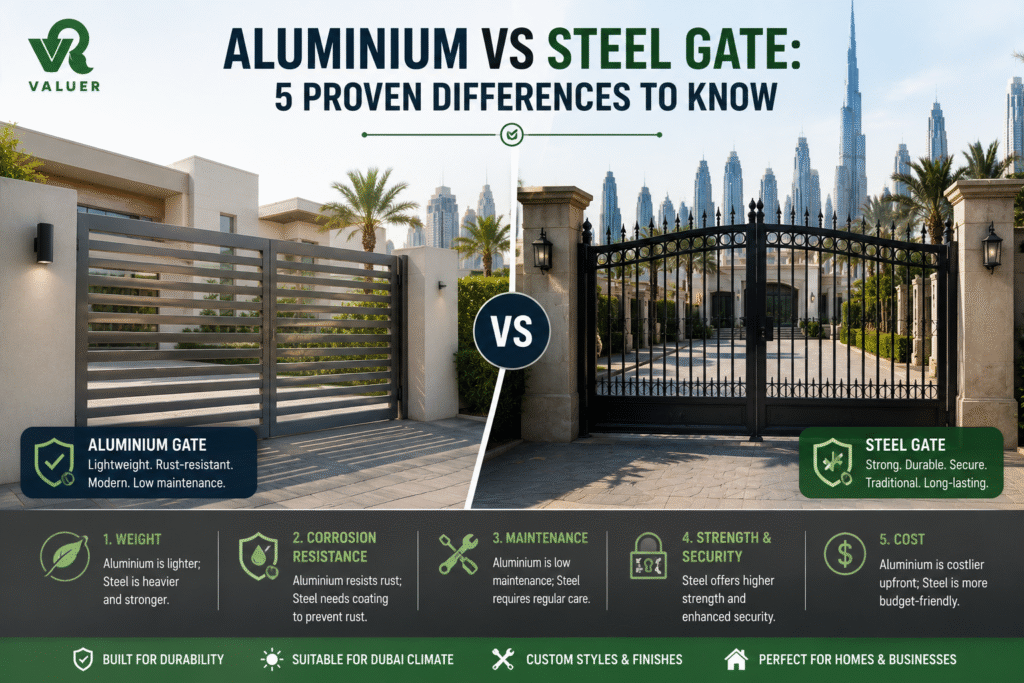
The aluminium vs steel gate debate is one of the most frequently asked questions among villa owners, property developers, commercial operators, and facilities managers across the UAE and beyond — and for good reason. Your entrance gate is simultaneously your property’s first visual impression, its primary security barrier, and a long-term infrastructure investment that will be with you for 15 to 25 or more years. Getting the material decision wrong at the specification stage costs significantly more to correct than it would have cost to get right the first time.
At Valuer UAE, we design, fabricate, and install both aluminium and steel gates across the UAE — and we have hands-on experience with how each material actually performs across years of daily use in the region’s extreme climate. In this guide, we give you an honest, direct, and comprehensive breakdown of the 5 proven differences between aluminium and steel gates so you can make the right choice for your specific property, application, and budget.
Why the Aluminium vs Steel Gate Decision Matters More Than Ever in 2026
Gate material selection has become a more consequential decision in 2026 than it was even five years ago — for three specific reasons that are directly relevant to property owners and managers across the UAE.
First, Dubai’s RTA January 2026 permit system for residential gate installations now mandates specific structural performance standards including wind load resistance of 120 kilometres per hour or more — meaning the material you choose must meet a defined engineering threshold, not just look good. Second, smart home automation adoption is now standard across new villa installations across Dubai’s premium communities — and the weight difference between aluminium and steel directly impacts motor specification, running costs, and long-term automation reliability. Third, Dubai’s villa market reached AED 221.4 billion in transaction value in H1 2026 — making entrance gate quality a genuinely visible and financially significant component of property presentation and resale value.
Difference 1 — Strength and Security Performance
This is where the aluminium vs steel gate comparison is most frequently misunderstood — and where getting the decision wrong creates the most serious consequences.
Steel is much stronger than aluminium. It doesn’t bend so easily. Aluminium, on the other hand, is more easily bent and therefore not the best option for properties that require high-level security. Jndtimberandsteel
Steel gates can last as long as seventy years if properly maintained — and if repairs are needed, can be welded to restore any age-related loss of integrity, making steel the definitive material choice for applications where maximum structural strength and forced entry resistance are the primary specification driver. Real Property Management
For residential villa applications in standard communities across the UAE, the structural performance difference between aluminium and steel is rarely a practical concern — both materials provide adequate security when correctly specified. For commercial properties, industrial facilities, high-security compounds, and large perimeter gates subject to vehicle impact risk, steel wins this comparison unambiguously.
Verdict — Aluminium vs steel gate for security: Steel wins for high-security commercial and industrial applications. Aluminium is sufficient for most residential and light commercial applications.
Difference 2 — Corrosion Resistance and Climate Performance
This is the single most important material performance difference for property owners across the UAE — where the combination of coastal salt air, extreme heat, high humidity, and intense UV radiation creates one of the most aggressively corrosive outdoor environments for metal structures on the planet.
Aluminium is resistant to weathering and corrosion — aluminium gates and fences will stand the test of time for longer than steel, making aluminium the superior choice for properties requiring lesser upkeep that will last a long time. Jndtimberandsteel
Steel of even the highest quality is going to rust if not finished well and retouched or repainted often — whereas aluminium is the most cost-efficient material regarding metal options, and its natural corrosion resistance eliminates the ongoing surface treatment costs that steel ownership requires. Mulhollandbrand
In the UAE’s coastal environment — particularly across Palm Jumeirah, Dubai Marina, Jumeirah Beach Residence, and any beachfront or waterfront community — this difference is decisive. An untreated or poorly coated steel gate in a coastal UAE location shows visible rust within a single summer season. A quality aluminium gate in the same location requires no rust treatment across its entire operational life.
Contemporary aluminium gates are just as durable as gates made from iron or steel — they require very little in the way of maintenance, and an occasional wipe down with a damp cloth to remove surface dirt should keep them looking as good as new. Stargates
Verdict — Aluminium vs steel gate for UAE climate: Aluminium wins clearly — especially for coastal and waterfront locations across the UAE.
Difference 3 — Weight and Automation Compatibility
The weight difference between aluminium and steel is one of the most practically significant but least frequently discussed factors in the aluminium vs steel gate decision — with direct consequences for automation motor selection, long-term running costs, and maintenance requirements.
Aluminium is a lightweight, durable, and versatile material — due to the weight of steel fencing, steel gates may be more difficult to install than aluminium and less practical for home and family uses, making steel better suited to certain commercial and industrial applications over residential ones. Fencemakers
A standard double-leaf aluminium villa gate weighs approximately 60 to 120 kilograms depending on size and profile. An equivalent steel gate of the same physical dimensions weighs 150 to 300 kilograms or more. This weight difference directly determines:
- Motor size and cost — steel gates require significantly larger, more expensive motor systems
- Motor running costs — larger motors consume more electricity across thousands of daily cycles
- Motor thermal load — heavier gates generate higher motor operating temperatures in Dubai’s extreme summer ambient temperatures, directly impacting motor longevity
- Track and roller wear — heavier steel gates wear tracks and rollers significantly faster than equivalent aluminium installations
- Foundation requirements — heavier steel gates require deeper, more substantial post footings
For most residential villa applications across the UAE where automation is standard, aluminium’s lighter weight consistently delivers better total system cost of ownership over the gate’s operational life — even accounting for the higher per-kilogram material cost of aluminium versus mild steel.
Verdict — Aluminium vs steel gate for automation: Aluminium wins — lighter weight enables smaller, more reliable, and more cost-efficient motor systems.
Difference 4 — Maintenance Requirements and Long-Term Cost
The maintenance difference between aluminium and steel is where the total ownership cost comparison between the two materials most clearly favours aluminium for residential and most commercial applications — with steel’s higher upfront affordability regularly offset by ongoing maintenance expenses that aluminium owners never incur.
Aluminium is impervious to the elements and will not corrode or rust — while steel can rust but is well-protected and virtually maintenance-free when treated with a protective coating. For security-priority applications, steel fences are manufactured using welded construction, reinforcing an already solid material. MaintainFree
In practice, the maintenance comparison between aluminium and steel gates across the UAE over a 10-year ownership period looks like this:
A powder-coated aluminium gate requires virtually no maintenance beyond periodic cleaning and occasional hardware lubrication — with no repainting, rust treatment, or structural repair typically required across a 15 to 20 year lifespan when correctly specified and installed.
A powder-coated mild steel gate in the UAE requires annual inspection for coating damage and rust initiation, touch-up painting at any bare metal areas identified during inspection, periodic full repainting every 5 to 7 years as the original coating degrades under UV and salt air exposure, and potentially structural repair welding at stress points as the gate ages.
Any price advantage of steel over aluminium is gone when ongoing maintenance costs are factored into the total ownership comparison — making aluminium the more financially efficient choice for most residential and commercial gate applications over a full ownership lifecycle. Mulhollandbrand
Verdict — Aluminium vs steel gate for maintenance: Aluminium wins decisively — significantly lower total ownership cost across the gate’s operational life.
Difference 5 — Design Versatility and Aesthetic Options
The final dimension of the aluminium vs steel gate comparison is design capability — and this is where the answer is most nuanced, with each material offering distinct design strengths that suit different architectural styles and property types.
Both aluminium and steel come in a wide range of styles — but aluminium fencing offers a broader range of colour options, while steel allows more intricate ornamental fabrication through hand-forging and welded decorative elements that aluminium’s lower melting point makes harder to replicate at the same level of ornamental complexity. Mulhollandbrand
Aluminium excels in contemporary, geometric, and modern architectural gate designs — where clean powder-coated profiles, slim extrusion sections, and a wide RAL colour range deliver the precise, polished aesthetic that defines modern villa entrance design across Dubai’s contemporary residential communities. Aluminium is also compatible with sublimation wood-grain surface finishes — creating gates that replicate the visual warmth of timber without any of timber’s maintenance requirements.
Steel excels in traditional, ornamental, and heritage-inspired gate designs — where hand-forged scrollwork, cast decorative inserts, and the structural weight of steel deliver the architectural gravity and intricate detail that defines premium traditional villa entrance gates across the UAE’s more classically styled residential communities. Wrought iron and steel can be used to create beautiful designs, some of them quite intricate and specialised — making steel the preferred material for property owners who want a gate that reflects genuine craftsmanship and architectural character. Stargates
Verdict — Aluminium vs steel gate for design: Aluminium for contemporary and modern styles. Steel for ornamental, heritage, and traditional architectural applications.
Aluminium vs Steel Gate — The Complete Summary
| Factor | Aluminium Gate | Steel Gate |
|---|---|---|
| Structural strength | Good — sufficient for most residential use | Superior — required for high-security commercial and industrial |
| Corrosion resistance | Excellent — naturally rust-free in any climate | Good with coating — requires periodic maintenance to prevent rust |
| Weight | Light — enables efficient automation | Heavy — requires larger motor and deeper foundations |
| Maintenance | Minimal — clean only | Regular — inspection, touch-up, and periodic repainting |
| Total ownership cost | Lower over full lifecycle | Higher when maintenance included |
| Design versatility | Best for modern and contemporary | Best for ornamental and heritage styles |
| Best for UAE climate | Strongly recommended — especially coastal | Suitable for inland applications with proper coating and maintenance |
Which Should You Choose for Your Property?
Choose aluminium if your property is in a coastal or humid location, you want automation with a reliable and cost-efficient motor system, your architectural style is contemporary or modern, and you want a gate that requires minimal ongoing maintenance across a 15 to 25 year operational life.
Choose steel if your application requires maximum forced entry resistance and structural strength, your property’s architectural style is traditional, ornamental, or heritage-inspired, you want hand-forged or cast decorative detail that defines a truly distinctive entrance, or your installation is a commercial or industrial security gate where structural performance is the non-negotiable priority.
At Valuer UAE, we fabricate and install both aluminium and steel gates across the UAE — and our team will guide you through the right material decision for your specific property, location, and application. According to Dubai Municipality, all permanent gate structures must comply with applicable building codes, wind load standards, and setback regulations — Valuer UAE manages full permit compliance on every installation.
Explore our full range: Gates and Fencing — Valuer UAE. Looking for gate and fencing solutions? Explore our full range including aluminium gate, steel gate, cast aluminium gate, and fencing solutions across the UAE.
Frequently Asked Questions — Aluminium vs Steel Gate
Is aluminium or steel better for a villa gate in the UAE?
For most residential villa applications across the UAE — especially in coastal communities including Palm Jumeirah, Dubai Marina, and JBR — aluminium is the recommended choice. Its natural corrosion resistance, lighter weight for automation, and minimal maintenance requirements deliver better total ownership value than steel across the UAE’s extreme climate.
Which is stronger — an aluminium or steel gate?
Steel is structurally stronger than aluminium and provides superior forced entry resistance — making it the preferred material for high-security commercial, industrial, and institutional gate applications. For standard residential villa security requirements, a correctly specified aluminium gate provides adequate structural performance.
Does a steel gate rust in the UAE climate?
Yes, mild steel gates will rust in the UAE’s coastal salt air and humidity if the protective coating is not properly maintained. Annual inspection and touch-up painting are essential for steel gates across the UAE — particularly in beachfront and marina locations where salt spray exposure is highest.
Is aluminium or steel more expensive for a gate?
Steel typically costs less per kilogram than aluminium — making steel gates lower in upfront material cost for equivalent sizes. However, when ongoing maintenance costs are factored into the comparison, aluminium delivers lower total ownership cost over a full 15 to 25 year gate lifecycle for most residential and commercial applications.
Can Valuer UAE help me choose between aluminium and steel for my gate?
Yes. Contact Valuer UAE via our enquiry form, email hello@valueruae.com, or WhatsApp +971 52 653 4567 — our team will assess your property, location, security requirements, and architectural style to recommend the right material for your specific application.