
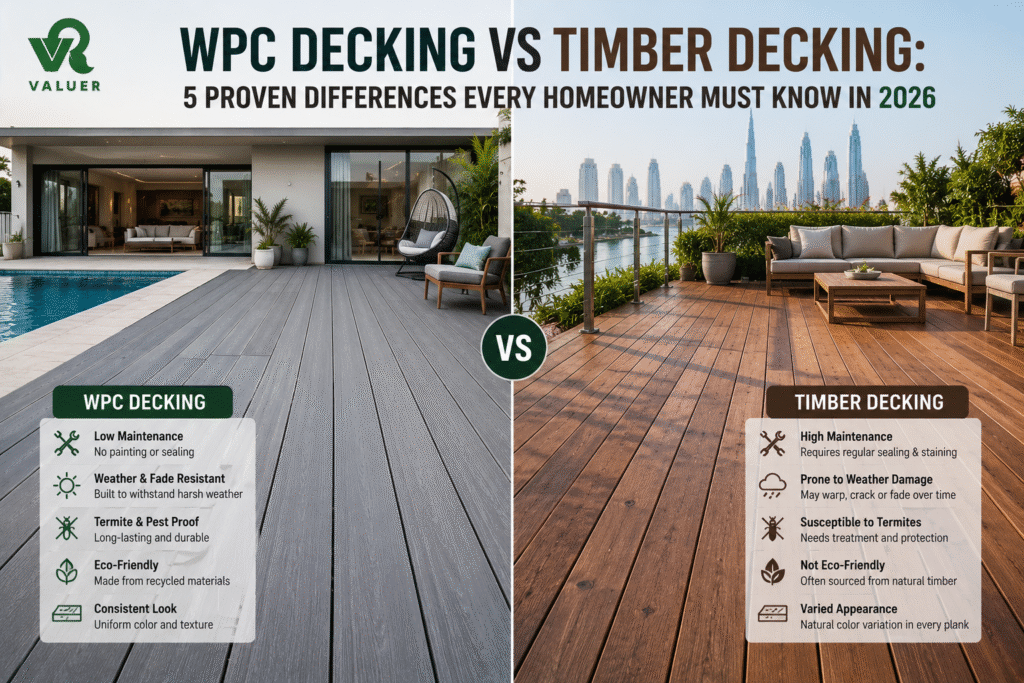
WPC decking vs timber decking — it is the most debated outdoor flooring question among homeowners, property developers, hospitality designers, and landscape architects in 2026. Both materials can create stunning outdoor spaces. Both have passionate advocates. And both come with genuine advantages that the other cannot fully replicate. The difference is in understanding exactly what each material delivers across the specific set of conditions your outdoor space actually faces — and making your decision based on facts, not marketing.
One of the most significant shifts in the composite materials sector over the past three years is the emergence of fully integrated WPC outdoor product ecosystems — with homeowners and developers now specifying composite materials across every exterior surface, creating cohesive, zero-maintenance outdoor environments with a unified aesthetic language. At the same time, timber still commands genuine respect and loyalty from property owners who value the irreplaceable warmth, character, and natural beauty of real wood. BOHAI
At Valuer UAE, we supply and install WPC decking across the UAE — and we have seen firsthand how each material actually performs across years of daily use in one of the world’s most demanding outdoor climates. This guide gives you an honest, direct, and comprehensive breakdown of the 5 proven differences between WPC and timber decking so you can make the right choice for your specific project, budget, and lifestyle.
The Core Question — What Are You Actually Buying?
Before diving into the comparison, it helps to understand exactly what each material is.
Timber decking uses natural wood — typically hardwoods like teak, merbau, iroko, or ipe, or treated softwoods like pine and cedar. It is cut, dried, and treated before installation — and it behaves like wood throughout its operational life, expanding, contracting, absorbing moisture, and responding to UV and heat in ways that require ongoing management.
WPC decking — wood-plastic composite — is an engineered material typically combining 45 to 60% wood fibres with 40 to 55% high-density polyethylene plastic, plus UV stabilisers, colourants, and bonding agents. WPC decking is a blend of wood fibres and recycled plastic offering superior durability and low maintenance — resistant to moisture, mould, and insects — making it the dominant choice for modern outdoor spaces where long-term performance matters as much as aesthetics. Wpc-china
With that foundation established, here are the 5 differences that actually determine which material is right for your project.
Difference 1 — Durability and Lifespan
This is the most practically significant difference in the WPC decking vs timber decking comparison — and where the performance gap between the two materials is most dramatic.
Wooden decking typically lasts 10 to 15 years with proper care, while WPC decking can endure for 25 to 30 years or longer with minimal maintenance. Wpc-china
In terms of durability and lifespan, WPC composite decking generally outperforms WPC vs timber decking — with maintenance costs significantly affecting the total lifecycle cost of decking materials. SolidexWood
The durability gap is amplified dramatically in hot, humid, and coastal climates — precisely the conditions that define outdoor environments across the UAE. In Dubai’s summer, surface temperatures on south and west-facing timber decks regularly exceed 60 to 70 degrees Celsius — driving moisture out of the timber fibres and accelerating the cracking, checking, and splitting that progressively destroys WPC decking vs timber decking from within. Salt-laden coastal air accelerates the degradation of timber further, attacking both the wood fibres and any surface coating applied to protect them.
Capped composite performs well in coastal climates where salt air and humidity challenge both materials — while wood requires more frequent sealing and inspection to maintain structural integrity across seasons. YuHeng WPC
Co-extruded WPC decking — where a protective polymer cap is applied around the composite core during manufacturing — adds a further layer of protection against moisture penetration, UV fading, and surface wear that gives premium WPC products a genuine 25 to 30 year operational lifespan even in demanding Gulf climate conditions.
Verdict: WPC wins decisively on durability and lifespan — particularly in hot, humid, and coastal outdoor environments.
Difference 2 — Maintenance Requirements
The maintenance difference in the WPC decking vs timber decking comparison is arguably the most impactful on day-to-day quality of life — and the factor most frequently underestimated by homeowners choosing timber for the first time.
Maintenance requirements differ significantly — wooden decking needs annual sealing and staining, while WPC decking only requires occasional cleaning. WPC decking requires 90% less maintenance than equivalent timber installations. Wpc-china
Here is what timber decking maintenance actually looks like across a typical 15-year ownership period in the UAE’s climate:
Year one — sanding and re-sealing following first monsoon season. Year two and three — annual inspection for cracking and checking, sanding back damaged areas, full recoat application. Year five — significant cracking on south and west-facing boards requiring section replacement. Year seven — full sanding back to bare wood and complete recoat. Year ten — major structural assessment with likely partial board replacement across high-UV exposure areas. Years twelve to fifteen — progressive replacement of remaining boards as structural deterioration exceeds cosmetic repair capacity.
WPC decking maintenance across the same 15-year period is occasional hosing down, periodic mild detergent cleaning for staining, and replacement of any individual boards damaged by physical impact. That is it.
The value proposition of composite decking over timber is strongest when evaluated over a realistic project lifespan rather than initial material cost alone — with WPC typically carrying a 20 to 30% higher upfront material cost than pressure-treated pine, but this gap inverting dramatically once maintenance, refinishing, and early replacement are factored in. BOHAI
Verdict: WPC wins comprehensively on maintenance — requiring a fraction of the time, cost, and effort that timber ownership demands.
Difference 3 — Cost — Upfront vs Total Ownership
The cost comparison in the WPC decking vs timber decking debate is the one most frequently misrepresented — because upfront material cost and total ownership cost tell completely different stories.
Recent estimates state that the cost of WPC decking with installation ranges from $15 to $30 per square foot, while wood decking such as treated lumber averages $10 to $20 per square foot — with hardwood options like teak and cedar reaching $20 to $35 per square foot. YuHeng WPC
In the UAE market, WPC decking supply and install pricing typically ranges from AED 180 to AED 350 per square metre for standard hollow-profile boards, rising to AED 300 to AED 550 per square metre for premium co-extruded solid-profile products. Timber decking — depending on species — ranges from AED 120 to AED 450 per square metre supply and install for treated softwood through to premium tropical hardwood species.
So timber can be cheaper upfront. But the total ownership cost comparison over a realistic 15 to 20 year project lifespan consistently favours WPC:
WPC decking with its high quality and long lifespan can be used for more than 20 years with no fading and low maintenance — as the average annual cost goes down significantly over time, making WPC the more cost-effective choice when evaluated across a full ownership lifecycle. Wallong-wpc
A 30 square metre timer deck at AED 200 per square metre costs AED 6,000 upfront — but with annual maintenance at AED 1,500 to AED 2,500 per year across a 15-year lifespan, total ownership cost exceeds AED 30,000. An equivalent WPC deck at AED 280 per square metre costs AED 8,400 upfront — with near-zero annual maintenance cost, total ownership cost across the same 15 years remains close to AED 9,000 to AED 10,000.
Verdict: Timber wins on upfront cost. WPC wins decisively on total ownership cost across any realistic project lifespan. A brief over view on WPC Decking vs Timber Decking
Difference 4 — Aesthetics and Feel
This is the one area of the WPC decking vs timber decking comparison where timber retains a genuine, uncontested advantage — and where the honest answer is that no manufactured product fully replicates the experience of real wood.
Wood offers natural grain variation, colour richness, and the ability to change appearance with stain. No manufactured product fully replicates real timber. YuHeng WPC
Real timber decking has a warmth, depth, and natural character that comes from the material itself — the grain patterns that vary across every board, the way light plays across a naturally textured surface, and the organic imperfection that gives timber its authenticity. For property owners who genuinely value this aesthetic above all other considerations, timber remains the choice that WPC cannot fully replace.
WPC decking has closed this gap significantly with high-definition embossed wood grain textures, co-extruded surface finishes, and a wide range of realistic colour options — and for most observers viewing a quality WPC deck from normal distances, the visual difference from real timber is minimal. Hot and sunny climates present one practical aesthetic challenge for darker WPC — it retains more heat underfoot than lighter timber, with light colours and heat-reflective pigments reducing heat retention in composite boards. YuHeng WPC
For outdoor spaces in the UAE, this heat retention characteristic is worth understanding before choosing a dark WPC colour for a west-facing or high-sun-exposure deck area — light grey and natural wood tones in WPC consistently perform better underfoot in direct afternoon sun than dark charcoal or espresso alternatives.
Verdict: Timber wins on pure natural aesthetics. WPC delivers an excellent visual result that satisfies the vast majority of residential and commercial applications. A brief overview on WPC Decking vs Timber Decking
Difference 5 — Environmental Impact and Sustainability
The final dimension of the WPC decking vs timber decking comparison is increasingly important to property owners, developers, and commercial operators aligning their material choices with sustainability commitments — particularly relevant across the UAE where the Net Zero 2050 Strategic Initiative is driving sustainability awareness across every sector of the property and construction market.
Environmentally, WPC is more sustainable due to its use of recycled materials — while the ecological impact of wooden decking depends on responsible sourcing practices and whether the timber carries credible Forest Stewardship Council or equivalent certification. Wpc-china
With the global construction industry increasingly focusing on durability, sustainability, and lifecycle cost, WPC composite decking has become one of the fastest-growing outdoor flooring materials — with its use of recycled plastic and wood fibre reducing virgin material consumption and manufacturing environmental impact compared to virgin timber alternatives. SolidexWood
The sustainability comparison is nuanced. Responsibly sourced, FSC-certified timber from well-managed forests carries a strong sustainability credential — particularly if the timber species has a long operational lifespan that offsets its production carbon. WPC’s use of recycled post-consumer plastic in its composition addresses the global plastic waste problem directly — and its 25 to 30 year lifespan with zero chemical treatment requirements eliminates the annual coating and sealing chemical burden that timber maintenance imposes across its operational life.
Verdict: Both materials have credible sustainability credentials when correctly specified and sourced. WPC’s use of recycled materials and chemical-free operational life gives it a meaningful edge for sustainability-conscious buyers. A brief overview on WPC Decking vs Timber Decking
WPC Decking vs Timber Decking — The Complete Summary
| Factor | WPC Decking | Timber Decking |
|---|---|---|
| Lifespan | 25 to 30 or more years | 10 to 15 years with proper maintenance |
| Maintenance | Minimal — occasional cleaning only | High — annual staining, sealing, inspection |
| Upfront cost | 20 to 30% higher than treated timber | Lower for softwood, comparable for hardwood |
| Total ownership cost | Significantly lower over 15 to 20 years | Higher when maintenance included |
| Aesthetics | Excellent — closely replicates timber | Superior — natural grain, warmth, character |
| Climate performance in UAE | Excellent — UV and moisture resistant | Challenging — requires intensive maintenance |
| Sustainability | Strong — recycled materials composition | Good — depends on FSC certification |
| Best for | Most residential and commercial projects | Property owners who prioritise natural wood aesthetics above all else |
Which Should You Choose?
Choose WPC decking if you want a low-maintenance outdoor space that performs reliably across 25 or more years, if your property is in a hot, humid, or coastal location, if total ownership cost matters more than upfront price, or if sustainability credentials are important to your project or business.
Choose timber decking if the irreplaceable natural aesthetic of real wood is your absolute priority above cost, maintenance, and longevity, if you are committed to the annual maintenance programme that timber requires in the UAE’s climate, and if the warmth and character of genuine timber matters more to you than the practical advantages of a composite alternative.
At Valuer UAE, we supply and install premium WPC decking across the UAE for residential villas, hotels, restaurants, and commercial properties. According to Dubai Municipality, all outdoor flooring and decking installations must comply with applicable building safety and fire performance standards — Valuer UAE ensures full compliance on every installation.
Explore our WPC decking range: WPC Decking — Valuer UAE
Frequently Asked Questions — WPC Decking vs Timber Decking
Is WPC decking better than timber for outdoor use in the UAE?
For most outdoor applications in the UAE’s hot, humid, and coastal climate, WPC decking significantly outperforms timber — requiring 90% less maintenance, lasting 25 to 30 years versus timber’s 10 to 15, and maintaining its appearance and structural integrity without the annual staining and sealing that timber demands in Gulf climate conditions.
Is WPC decking more expensive than timber?
WPC decking carries a 20 to 30% higher upfront cost than treated softwood timber alternatives. However, when annual maintenance costs — staining, sealing, and board replacement — are factored into the comparison across a realistic 15 to 20 year project lifespan, WPC consistently delivers lower total ownership cost than equivalent timber installations.
Does WPC decking look as good as real timber?
Modern WPC decking with high-definition embossed wood grain textures and co-extruded surface finishes closely replicates the visual appearance of real timber for most observers in residential and commercial settings. Natural timber retains a genuine aesthetic advantage in grain variation, depth, and organic character that no manufactured product fully replicates.
How long does WPC decking last compared to timber?
Quality WPC decking lasts 25 to 30 or more years with minimal maintenance. Timber decking in the UAE’s climate typically lasts 10 to 15 years with proper annual maintenance — with lifespan significantly reduced in coastal, high-humidity, or south and west-facing sun-exposure locations.
Where can I get WPC decking installed across the UAE?
Contact Valuer UAE via our enquiry form, email hello@valueruae.com, or WhatsApp +971 52 653 4567 for a fast, itemised quote on WPC decking supply and installation across Dubai, Sharjah, Abu Dhabi, and the wider UAE.