
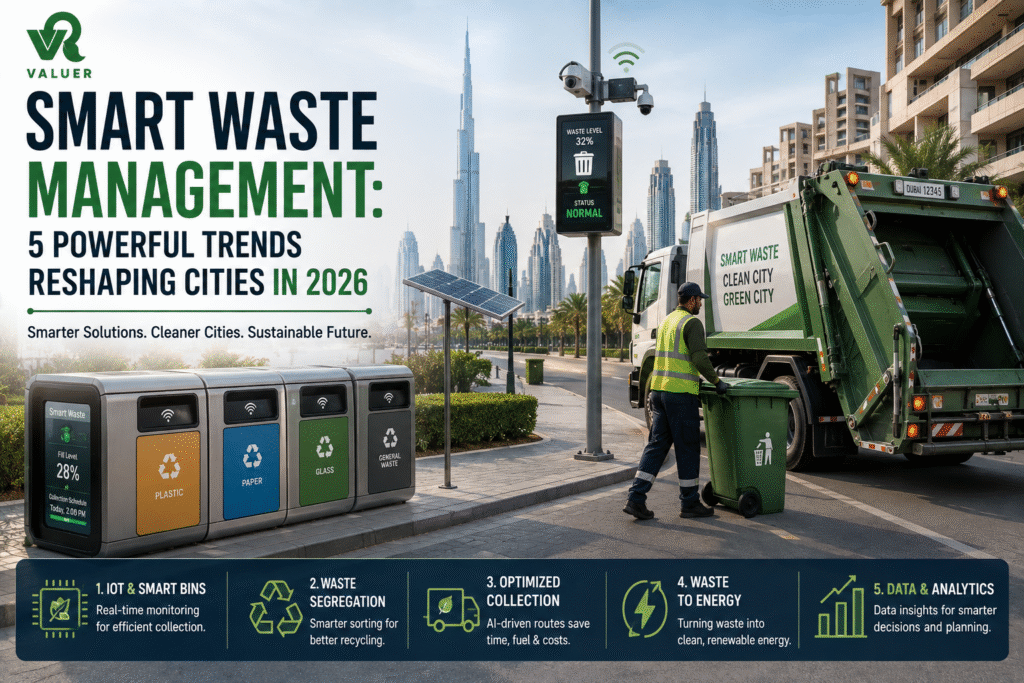
Smart waste management is no longer a futuristic concept — it is the operational reality transforming how cities, municipalities, property developers, and businesses handle waste collection, segregation, and disposal across the globe in 2026. The global smart waste management market was valued at USD 2.5 billion in 2024 and is estimated to reach USD 5.7 billion by 2033, growing at a CAGR of 9.8% — driven by urban sustainability initiatives, technological innovation, and evolving waste management policies that are making traditional waste disposal methods increasingly insufficient for the scale and complexity of modern cities. Verified Market Reports
For businesses, property managers, municipalities, and developers across the UAE — where Dubai has already hit a 65% waste diversion rate and is targeting zero landfill by 2030 — understanding where smart waste management is heading in 2026 is not just an environmental interest. It is a strategic operational and compliance priority that directly impacts cost management, regulatory standing, and long-term property value.
Why Smart Waste Management Is the Defining Urban Challenge of 2026
The waste management sector is facing what industry analysts are calling a perfect storm in 2026 — rising waste volumes, strict new recycling regulations, chronic labour shortages, and spiralling operational costs are making the old model of fixed-schedule collection trucks running predetermined routes regardless of actual bin fill levels both financially and environmentally unsustainable. Smartends
In the UAE, BEEAH has deployed smart bins for real-time monitoring and implemented WastePro+, the region’s first end-to-end digital waste management platform — demonstrating that the Gulf region is not just observing the global smart waste management transition but actively leading it. Abu Dhabi’s Tadweer Group is running live trials of high-tech smart bins that use sensors and advanced technology to detect what has been deposited by community members and the fill level — helping Tadweer know how much and what kind of waste is inside and when to empty bins efficiently. ScienceDirectKhaleej Times
For property managers, facility managers, and waste management procurement teams across the UAE, understanding the five trends reshaping smart waste management in 2026 is essential context for every bin procurement, maintenance contract, and waste management infrastructure decision they make.
Trend 1 — AI-Powered Fill-Level Monitoring Is Replacing Fixed Collection Schedules
The single most impactful operational change in smart waste management in 2026 is the replacement of fixed collection schedules with dynamic, data-driven collection routing powered by AI and IoT fill-level sensors installed in waste bins across residential communities, commercial districts, and public spaces.
Instead of fixed schedules — collecting every Monday regardless of need — trucks now run on dynamic routes, visiting only the bins that need attention, leading to a 30 to 50% reduction in collection trips. This is the single fastest way for a city to lower fuel consumption and slash CO₂ emissions in the waste management sector. Smartends
IoT sensors on bins and fleet, plus real-time dashboards displaying hot spots for rapid intervention and strategic planning, are enabling Dubai’s smart waste management operations to transition from reactive to proactive systems — significantly impacting operational costs, environmental compliance, and urban livability across the emirate. Concept Zone LLC.
For property managers and facilities companies across the UAE, this trend has a direct practical implication — the galvanized metallic bins, plastic refuse bins, and metallic skips at the heart of their waste management infrastructure need to be in optimum physical condition to integrate with smart collection systems. A bin with a seized wheel, a failed dome lid, or a damaged lifting pocket creates collection failures that disrupt the data-driven collection scheduling that smart waste management systems depend on.
Trend 2 — AI Vision Systems Are Transforming Waste Segregation Accuracy
One of the most technically sophisticated developments in smart waste management in 2026 is the deployment of AI-powered computer vision systems at waste transfer stations, recycling facilities, and increasingly at the point of deposit — enabling real-time identification and segregation of waste types with accuracy levels that human sorting simply cannot match.
AI in waste management has moved rapidly from experimental luxury to operational necessity — computer vision systems are identifying contamination in waste streams with accuracy above 90%, preventing costly rejected loads and securing higher market prices for recovered recyclable materials across commercial and municipal waste operations. Smartends
In line with the UAE Artificial Intelligence Strategy 2031, the Environment Agency Abu Dhabi organised a workshop demonstrating how AI can improve operational efficiency, waste classification accuracy, and sustainability outcomes across the UAE’s waste management infrastructure — confirming that AI-powered waste segregation is now a formal policy priority at the highest levels of UAE government. gulfnews
For businesses across the UAE, this trend reinforces the importance of correct at-source waste segregation — since AI vision systems at transfer stations can identify and reject contaminated loads, making the financial and compliance consequences of poor segregation at the bin level more significant than ever before.
Trend 3 — Smart Bins Are Becoming Standard Infrastructure in UAE Communities
Smart trash bins integrating infrared sensors, ultrasonic sensors, Wi-Fi modules, and odour control systems to improve hygiene and waste management efficiency are growing at a CAGR of 14.1% — with more than 55% of smart bins now sold globally operating with automatic opening systems, while multi-compartment models account for nearly 60% of product demand. Business Research Insights
Abu Dhabi’s Tadweer trial of smart bins capable of detecting the type and fill level of deposited waste represents the UAE’s most advanced deployment of sensor-integrated waste infrastructure to date — with Dubai’s own smart bin rollout across Business Bay and Dubai Hills already delivering measurable improvements in collection efficiency and hygiene standards across these high-density urban environments. Khaleej Times
For property developers and community managers across the UAE, this trend signals a clear direction of travel — smart waste management infrastructure investment is moving from municipal responsibility toward an expectation of private property development. Communities and commercial developments that invest in smart-capable waste infrastructure today will be significantly better positioned for the regulatory environment and tenant expectations of 2027 and beyond.
Trend 4 — Waste Segregation Compliance Enforcement Is Intensifying Across the UAE
The trend with the most immediate and tangible impact on businesses and property managers across the UAE in 2026 is the intensification of waste segregation compliance enforcement — with AI-assisted inspections, surprise site visits, and Waste Transfer Note documentation requirements all tightening simultaneously across commercial and residential waste management operations.
Dubai’s smart waste management stack — connecting robotics, AI vision systems, bin data, and blockchain logs for chain-of-custody records — supports Dubai Smart City goals of cleaner streets, reliable service, lower emissions, and better use of power, while creating an enforcement infrastructure that makes non-compliance increasingly difficult to hide and increasingly costly when detected. Concept Zone LLC.
The practical consequence for any business, property manager, or facilities company operating waste management infrastructure across the UAE is straightforward — the physical condition, correct specification, and proper maintenance of every waste bin across every property is no longer a background operational detail. It is a frontline compliance asset that directly impacts a company’s standing during inspections, its waste contractor relationships, and its total waste management cost.
A correctly specified, well-maintained galvanized metallic bin — manufactured to DIN Standard 30736 and EN 12574, with a functioning dome lid, serviceable castor wheels, and intact lifting pockets — is the physical foundation that makes every layer of smart waste management above it work reliably. No amount of IoT sensor technology or AI collection routing compensates for a bin that cannot be lifted safely by a collection truck, or that overflows between collections because its capacity was undersized for the building it serves.
Trend 5 — Sustainability and Circular Economy Are Driving UAE Waste Infrastructure Investment
The fifth and most strategically significant trend in smart waste management across the UAE in 2026 is the alignment of waste infrastructure investment with the UAE’s national sustainability commitments — with the UAE Net Zero 2050 Strategic Initiative, Dubai’s zero landfill by 2030 target, and the UAE Circular Economy Policy all creating powerful incentives for private sector waste management upgrading across commercial, residential, and industrial property sectors.
Dubai’s investment in sorting bots, optical scanners, and waste-to-energy digesters is creating a green economy that ties into the UAE’s planning philosophy of harmonising environment, economy, and societal demands — with less landfill trips and more intelligent route design reducing fuel, labour, and tipping fees while creating measurable improvements in air quality and urban sustainability metrics. Concept Zone LLC.
For property developers, commercial operators, and facilities management companies across the UAE, this sustainability alignment creates both opportunity and obligation. Opportunity — because buildings and communities that demonstrate credible, documented waste management performance attract premium tenants, achieve higher LEED and Estidama certification scores, and command better positioning in Dubai and Abu Dhabi’s competitive commercial and residential property markets. Obligation — because the regulatory direction of travel is clear and non-negotiable.
What Smart Waste Management Means for Your Business Right Now
Understanding the five trends reshaping smart waste management in 2026 is valuable strategic context — but the most important question for any business or property manager across the UAE is what it means for the decisions they need to make today.
The answer is consistent across every trend — the physical waste management infrastructure your operation depends on must be in the best possible condition to perform reliably as the smart waste management ecosystem around it becomes more sophisticated, more data-driven, and more strictly enforced.
At Valuer UAE, we manufacture and supply the galvanized metallic bins, plastic refuse bins, metallic skips, and litter bins that form the physical foundation of waste management operations across thousands of residential, commercial, and industrial properties throughout the UAE. Our products are built to the standards — DIN 30736, EN 12574, and EN ISO 1461 — that ensure compatibility with municipality collection systems, compliance with Dubai Municipality and Abu Dhabi Municipality enforcement requirements, and the structural durability to perform reliably across years of demanding daily operational use.
According to Dubai Municipality, all commercial and residential properties must implement appropriate waste management solutions covering mandatory source segregation across all waste streams — making the quality, specification, and maintenance of your physical waste management infrastructure a genuine compliance and cost management priority in 2026.
Explore our full product range: Waste Management Solutions — Valuer UAE
Frequently Asked Questions About Smart Waste Management
What is smart waste management and how does it work?
Smart waste management uses IoT sensors, AI vision systems, data analytics, and dynamic collection routing to optimise every stage of the waste management process — from fill-level monitoring in individual bins through to AI-powered segregation at transfer stations and real-time collection scheduling that reduces unnecessary truck trips by 30 to 50%.
Is smart waste management being implemented in the UAE?
Yes. The UAE is among the most active adopters of smart waste management technology in the Middle East — with Dubai’s smart bin rollout across Business Bay and Dubai Hills, Abu Dhabi’s Tadweer smart bin trials, and BEEAH’s WastePro+ platform representing the region’s most advanced deployments of smart waste management infrastructure to date.
How does smart waste management reduce costs for businesses?
Smart waste management reduces costs through dynamic collection routing that eliminates unnecessary collections, improved segregation that increases recycling rebate income, reduced contaminated load rejection fees, and compliance documentation that protects businesses from Dubai Municipality enforcement fines that can reach AED 500,000 for serious waste management violations.
What role do physical bins play in a smart waste management system?
Physical bins — galvanized metallic bins, plastic refuse bins, and metallic skips — form the foundation of every smart waste management system. Fill-level sensors, collection compatibility, and correct segregation capacity all depend on bins being correctly specified, well maintained, and in full working order to enable the smart systems above them to function reliably.
How can Valuer UAE support my waste management operations?
Valuer UAE manufactures and supplies DIN and EN compliant galvanized metallic bins, plastic refuse bins, metallic skips, and litter bins across the UAE — providing the physical waste management infrastructure that keeps residential, commercial, and industrial operations compliant, efficient, and cost-effective.