
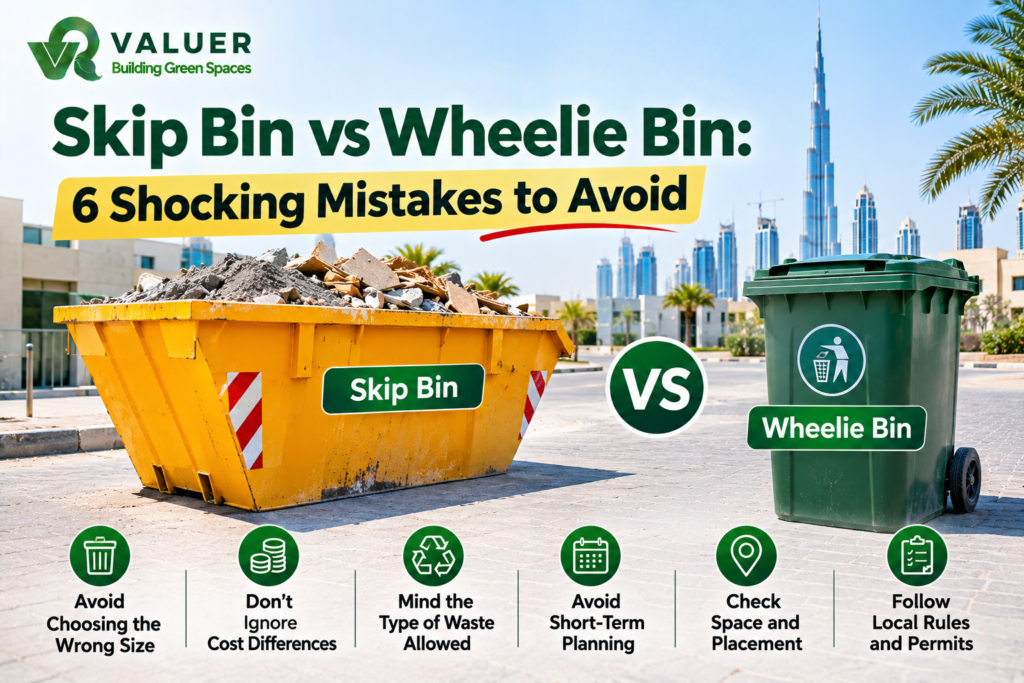
The skip bin vs wheelie bin question looks simple until the wrong container turns up on site. One is a heavy steel skip lifted by a truck. The other is a wheeled bin a person can roll to the kerb. Both hold waste, but they do very different jobs, and mixing them up costs real money. Get the skip bin vs wheelie bin choice right and collections run smoothly, areas stay clean and nobody pays for space they never needed.
At Valuer UAE we manufacture and supply metallic skips as well as galvanized and plastic bins for sites across the country. This guide walks through six mistakes we see again and again in the skip bin vs wheelie bin decision, and how to avoid every one of them.
Skip Bin vs Wheelie Bin: What Each One Is Actually Built to Do
A skip is a large steel container, open-top or covered, made for bulky and heavy waste such as rubble, demolition debris, scrap metal and clear-outs. It is lifted by a collection vehicle, and sizes run from around 5.5 CBM up to 15 CBM in our range. A wheelie bin is a smaller wheeled container for everyday waste from kitchens, offices, shops and apartment buildings. It is rolled by hand to a collection point and emptied by a bin-lift truck.
Think of it this way: skips are for projects, wheelie bins are for routine. Most sites eventually need both, so the skip bin vs wheelie bin debate is rarely either-or. It is really about matching the container to the job. Once you see it like that, the six mistakes below become much easier to spot.
Mistakes 1 and 2 in the Skip Bin vs Wheelie Bin Choice: Price and Volume
Mistake 1: choosing by unit price. A wheelie bin looks cheap next to a skip, but ten of them on a construction site cost more in labour, space and handling than one correctly sized skip. For bulk waste, the skip is almost always cheaper per cubic metre. For light daily waste, wheelie bins are far cheaper to run than any skip.
Mistake 2: guessing volume. Wheelie bins are sold in litres and skips in cubic metres, which confuses many buyers. One CBM equals 1,000 litres, so a 5.5 CBM skip holds 5,500 litres, roughly the same as 23 standard 240-litre wheelie bins. Convert both to the same unit before you compare them. Done properly, the skip bin vs wheelie bin maths makes the right answer obvious for your waste volume.
Mistakes 3 and 4 in the Skip Bin vs Wheelie Bin Choice: Weight and Access
Mistake 3: ignoring weight. Wheelie bins have load limits and are pushed by hand. Fill one with tiles, concrete or wet sand and the wheels break, the lid warps and someone gets hurt. Heavy waste belongs in a skip built for it, and even then you must stay inside the lifting limit. Weight is the first question in any skip bin vs wheelie bin comparison for building and refurbishment work.
Mistake 4: ignoring access. Skips need room for the truck, clear height above the container and firm, level ground. Wheelie bins need a clear route, a gentle ramp and a storage spot that the collection crew can reach. A skip that cannot be lifted and a bin that cannot be wheeled out are equally useless. Walk the route from the waste point to the collection point before you decide on skip bin vs wheelie bin, and ask your contractor which lifting method they use.
Mistake 5 in the Skip Bin vs Wheelie Bin Choice: Weak Segregation
Many sites put everything into one skip or one black bin and hope for the best. That wastes recyclable material and can lead to rejected loads and higher disposal charges. The smartest skip bin vs wheelie bin plans use both containers on purpose: dedicated skips for bulk streams such as metal scrap, timber and mixed rubble, and colour-coded wheelie bins for daily streams such as general waste, dry recyclables and organics.
Colour coding keeps staff and workers on track without lengthy training. Our plastic refuse bins come in two-wheeled and four-wheeled formats and in segregation colours, which makes the wheelie bin side of a skip bin vs wheelie bin set-up simple to organise. Put recycling bins where recyclables are created, and keep skips for the heavy material that bins cannot handle.
Mistake 6 in the Skip Bin vs Wheelie Bin Choice: Ignoring Paperwork and Support
The last mistake happens after the purchase. Whichever way the skip bin vs wheelie bin decision goes, keep the Waste Transfer Note for every collection, because it proves your waste went to an approved facility. According to Dubai Municipality, waste should be handled by licensed operators and containers kept in serviceable condition. Missing paperwork is one of the easiest ways to turn a tidy site into a compliance headache.
Think about support too. Wheelie bins need replacement wheels and lids over time, and skips may need repairs to lifting points or doors. A supplier who can supply parts and repairs keeps the whole fleet working. Our metallic skips are built for heavy site use, and our guide to waste management solutions in Dubai shows how skips, bins and contractors fit together. To get a clear recommendation on skip bin vs wheelie bin for your site, use our contact page.
FAQs on Skip Bin vs Wheelie Bin
What is the main difference in skip bin vs wheelie bin?
A skip is a large lifted container for bulky and heavy waste, while a wheelie bin is a smaller wheeled container for everyday waste that is rolled by hand
When is skip bin vs wheelie bin an either-or choice?
Rarely. Most sites use skips for projects and bulk streams, and wheelie bins for daily waste, so the best answer is usually both.
How do I compare capacity in skip bin vs wheelie bin?
Convert both to the same unit. One CBM equals 1,000 litres, so a 5.5 CBM skip equals about 23 standard 240-litre wheelie bins.
Which is better for heavy waste in skip bin vs wheelie bin?
A skip, because wheelie bins have load limits and are moved by hand. Even skips have weight limits, so confirm the maximum load with your contractor.
How can I get advice on skip bin vs wheelie bin from Valuer UAE?
Use the enquiry form on our contact page, email hello@valueruae.com, or WhatsApp +971 52 653 4567 with your waste types, volumes and site access.