
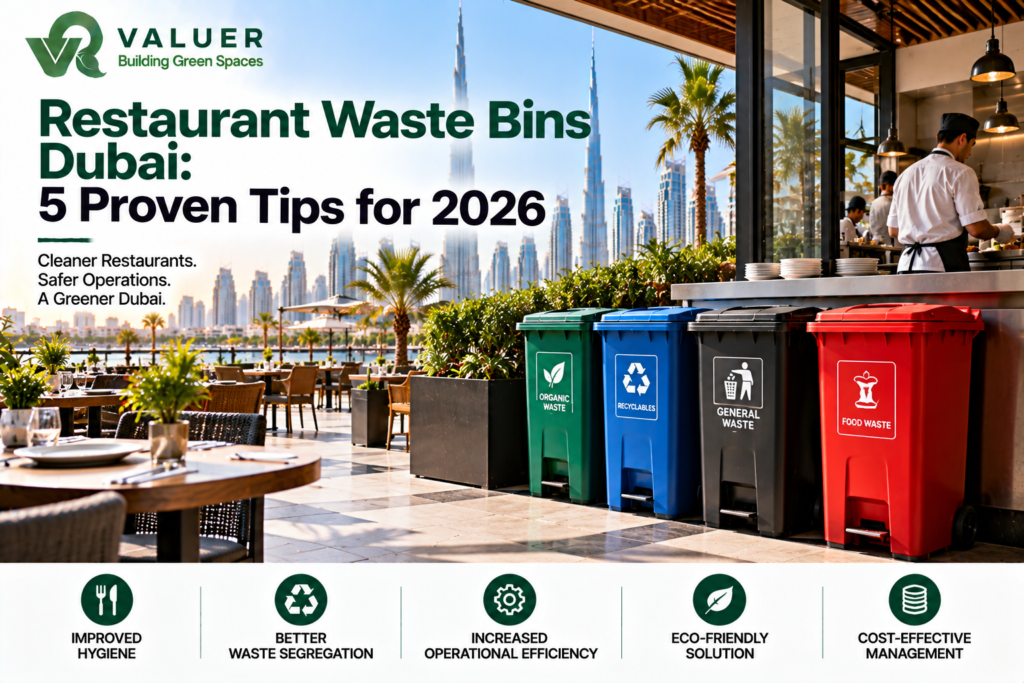
Restaurant waste bins Dubai operators choose shape hygiene scores, inspection results and kitchen workflow every single day. In a city where thousands of restaurants, cafés and cloud kitchens compete on guest experience, the bins behind the pass are rarely noticed until they overflow, smell or fail an inspection. Getting restaurant waste bins Dubai specification right is one of the cheapest ways to protect a food business from complaints, pests and enforcement trouble.
Food waste is the heaviest, wettest and most odour-prone stream a hospitality operation produces, and Dubai’s heat speeds up every problem it causes. At Valuer UAE we manufacture and supply bins used across the country’s waste infrastructure. This guide covers the five tips that matter most when selecting restaurant waste bins Dubai kitchens can depend on in 2026.
Size and Specify Restaurant Waste Bins Dubai Kitchens Actually Need
A restaurant is not an office, and the restaurant waste bins Dubai food businesses install must cope with wet organic waste, grease, hot packaging and constant lid use. Generic indoor bins warp, leak and hold odours quickly in these conditions, so restaurant waste bins Dubai buyers should be specified for the kitchen environment rather than bought as an afterthought.
Start with volume. Estimate daily waste from your covers, menu style and delivery packaging, then add a buffer for busy weekends and event nights. Most restaurants need small foot-operated bins at each prep station, feeding a larger central container for back-of-house storage until collection. For that central point, 1.1 CBM galvanized metallic bins suit mid-size restaurants and food courts, while larger operations can step up to the 2.5 CBM size. Undersized containers are the most common failure: they overflow before collection day and create exactly the visible mess that inspectors and neighbours notice first.
Separate Streams With Colour-Coded Restaurant Waste Bins Dubai Rules Expect
Segregation is where restaurant waste bins Dubai operators most often fall short. A kitchen produces at least three distinct streams: food and organic waste, dry recyclables such as cardboard, cans and bottles, and general waste. Dubai Municipality’s waste segregation framework expects these to be kept apart at source, and mixing them turns a recyclable load into a contaminated one that costs more to dispose of.
Colour coding makes this practical for busy staff. Matching each stream to a clearly labelled container at the point where the waste is created removes guesswork during a rush. Valuer UAE’s plastic refuse bins come in two-wheeled and four-wheeled formats and in the colour designations used for segregation, which lets a restaurant build a complete set of restaurant waste bins Dubai staff can follow without training sessions. Put the dry recycling bin beside the receiving area where cartons arrive, and the organic bin beside the prep line where trimmings are produced.
Control Odour and Pests Through Lids and Materials in Restaurant Waste Bins Dubai
Odour is the quality that guests and neighbours judge fastest, and the lid is the component that controls it. In warm weather, food waste begins to break down within hours, so open-top containers are a poor choice for restaurant waste bins Dubai outdoor service yards and bin rooms depend on.
Look for dome lids with a spring-loaded return and rubber beading, so the bin seals itself after every deposit rather than relying on staff to close it. For bins that sit outside, hot-dip galvanized steel resists the combination of heat, humidity, cleaning chemicals and food acids that attack lesser materials. Smooth interiors make washing easier, which matters because grease residue is what attracts flies and rodents. Whichever material you pick, ask the supplier for the galvanizing standard in writing. Restaurant waste bins Dubai kitchens buy on price alone often rust at the base within a season, and a rusted bin cannot be sanitised properly.
Place Restaurant Waste Bins Dubai Guests and Staff Will Actually Use
Placement decides whether segregation works in practice. Inside the kitchen, restaurant waste bins Dubai chefs use should sit within a single step of each prep zone, with nothing blocking walkways or fire routes. Outside the kitchen, the bin store should be close to the delivery door but separated from food storage and dining areas.
Front-of-house deserves separate thought. Terraces, entrances and walkways need tidy public-facing containers, and weather-resistant litter bins with dual openings give guests an easy way to separate waste without stepping into the back of house. A bin that looks good and is easy to reach is used correctly; one hidden behind a planter is ignored. Review placement every few months, because menu changes, new equipment and seasonal trade all shift where waste is generated.
Maintain and Document Restaurant Waste Bins Dubai Inspectors May Ask About
Even well-chosen restaurant waste bins Dubai kitchens invest in need routine care. Wash and disinfect interiors on a fixed schedule, and check wheels, lid springs and seals monthly. A seized wheel makes a heavy bin hard to move to the collection point, and a failed spring leaves the lid open and the odour uncontrolled.
Keep a simple file with your licensed contractor’s details and the Waste Transfer Note for each collection, plus a short maintenance log. This paperwork is the evidence of good practice if an inspector visits. According to Dubai Municipality, food premises must manage waste hygienically and use licensed collectors. If you want the whole picture of what a compliant set-up involves, our overview of waste management solutions explains how the container types fit together, and the galvanized metallic bins range covers the heavy-duty options for central storage.
FAQs — Restaurant Waste Bins Dubai
What size restaurant waste bins Dubai kitchens need?
It depends on covers and menu, but most restaurants use small foot-operated bins at prep stations feeding a central bin, commonly a 1.1 CBM galvanized unit for mid-size venues and 2.5 CBM for larger operations.
Do restaurant waste bins Dubai rules require separate food waste bins?
Dubai Municipality’s segregation framework expects organic, recyclable and general waste to be kept apart at source, so separate, clearly labelled containers are the safest approach.
Which material is best for restaurant waste bins Dubai outdoors?
Hot-dip galvanized steel with a dome lid and rubber seal handles heat, humidity and food acids well, while UV-stabilised plastic suits covered indoor areas.
How often should restaurant waste bins Dubai kitchens be cleaned?
Wash and disinfect interiors on a fixed schedule, ideally after every collection for organic bins, and inspect wheels, lids and seals monthly.
How do I get a quote for restaurant waste bins Dubai from Valuer UAE?
Send your requirements through the enquiry form, email hello@valueruae.com, or WhatsApp +971 52 653 4567 for a fast itemised quote.