
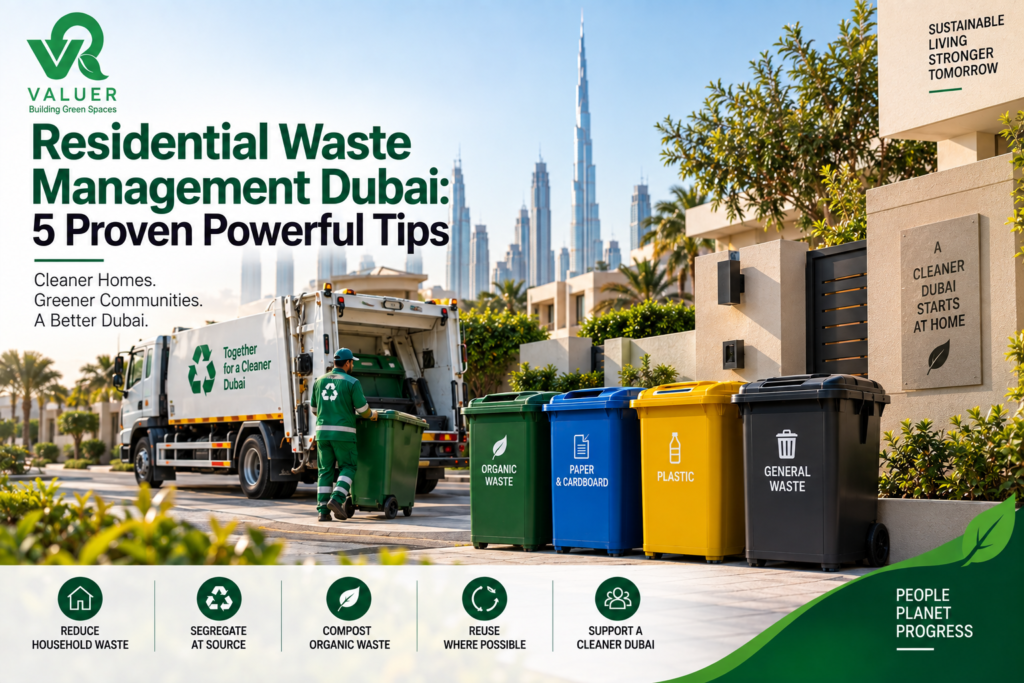
Residential waste management Dubai property managers are responsible for has never been more operationally complex or more actively scrutinised by Dubai Municipality’s enforcement teams than it is in 2026. More than 18,000 residential units were handed over across Dubai in Q1 2026 alone — a 27% increase on the same period last year — adding thousands of new occupied towers, villa communities, and mixed-use developments to the emirate’s residential waste collection infrastructure almost simultaneously, and creating a wave of new property managers and owners association representatives who are learning residential waste management Dubai requirements for the first time under a compliance framework that has moved decisively from guidance to enforcement.
The consequences of getting residential waste management Dubai wrong are no longer theoretical for property managers. Overflowing refuse rooms generate resident escalations that become owners association complaints. Non-compliant waste containers create collection failures that Dubai Municipality inspectors document. Inadequate waste segregation across residential common areas triggers rejected loads and additional disposal fees that appear as unexplained cost overruns on facilities management budgets. This guide gives property managers the five most important tips for getting residential waste management Dubai right across their portfolio in 2026.
Why Residential Waste Management Dubai Has Become a Priority for Property Managers
The residential property management landscape in Dubai in 2026 is shaped by three forces that collectively make residential waste management Dubai a frontline operational priority for any property manager who wants to retain management contracts, maintain resident satisfaction scores, and avoid the compliance exposure that Dubai Municipality’s increasingly active inspection programme creates.
First, the Dubai Land Department’s Mollak System enforces 100% transparency on service charge expenditure — meaning owners association members can now review exactly what their service charge is being spent on, making the quality of residential waste management Dubai services directly visible and directly contestable in a way that was not possible before Mollak’s implementation. Second, resident expectations across Dubai’s post-pandemic residential market have risen significantly — with waste management quality now regularly cited in resident satisfaction surveys as a direct contributor to renewal decisions. Third, Law No. 18 of 2024 mandates waste segregation across all residential premises — extending the compliance obligations that previously focused primarily on commercial operators to the residential sector with increasing enforcement intensity.
Tip 1 — Container Infrastructure Is the Foundation of Residential Waste Management Dubai
No residential waste management Dubai programme can perform better than the physical infrastructure it relies on — and the most common infrastructure failure across Dubai’s residential stock is undersized container capacity that creates overflow between collection cycles. Valuer UAE’s galvanized metallic bins in 1.1 CBM, 2.5 CBM, and 4.5 CBM configurations cover the full range of capacity requirements for residential waste management Dubai programmes — from single-tower buildings with moderate daily generation through to large master-planned communities with multiple buildings sharing centralised waste collection infrastructure.
The sizing calculation for residential waste management Dubai container infrastructure uses three variables — the number of occupied residential units served by each collection point, the average daily waste generation per unit, and the collection frequency available from the building’s licensed waste contractor. Most Dubai residential towers serving 50 to 150 units with daily collection require two 1.1 CBM galvanized bins at each refuse room collection point — with high-occupancy towers above 150 units typically requiring either multiple 1.1 CBM bins or a step-up to 2.5 CBM capacity to avoid the overflow that damages resident satisfaction and triggers Dubai Municipality non-compliance citations.
Tip 2 — Garbage Chute Systems Need Specific Residential Waste Management Dubai Attention
The garbage chute system is the waste collection component that most directly affects daily resident experience in Dubai’s high-rise residential towers — and the most impactful single residential waste management Dubai infrastructure investment any property manager responsible for a high-rise building can make is ensuring the chute system’s collection bin at the base is correctly specified, correctly maintained, and sufficiently sized for the building’s actual daily generation volume.
The galvanized metallic bin at the base of a residential garbage chute system is the hardest-working waste container in any high-rise property — subject to continuous impact loading as waste discharges from multiple floors above ground level, creating structural demands that plastic alternatives cannot sustain across the daily operational cycle of a fully occupied Dubai residential tower. Dome lid construction with a functioning spring-loaded seal is non-negotiable for chute base collection bins across residential waste management Dubai high-rise applications — because an open bin beneath an active garbage chute creates odour spread through the refuse room that generates the resident complaints property managers most consistently struggle to resolve.
Tip 3 — Segregation Infrastructure Transforms Residential Waste Management Dubai Performance
The mandatory waste segregation requirements embedded in Law No. 18 of 2024 extend explicitly to residential premises — making colour-coded segregation container infrastructure across residential common areas a compliance requirement rather than an optional sustainability enhancement for property managers responsible for residential waste management Dubai across their portfolio.
Implementing correctly colour-coded segregation across residential waste management Dubai common areas requires a minimum of two dedicated streams at every centralised collection point — a black general waste bin and a yellow dry recycling bin positioned together at every refuse room and outdoor collection area within the development. Plastic refuse bins in yellow designation from Valuer UAE are available in two-wheeled and four-wheeled configurations appropriate for different volume requirements across residential common area collection points — with the compact two-wheeled option well-suited to individual floor corridor positions and the four-wheeled option appropriate for higher-volume centralised refuse room positions.
Green or brown organic waste segregation bins are additionally required for residential developments with food service operations — including any residential community with a café, restaurant, or community kitchen facility — where organic waste volumes justify a dedicated stream separate from general waste.
Tip 4 — Litter Bin Coverage Completes Residential Waste Management Dubai Infrastructure
The litter bin network across residential common areas — lobby entrances, car park levels, pool decks, children’s play areas, walkways, and landscaped gardens — is the most publicly visible component of any residential waste management Dubai programme, and its condition and coverage are the first things residents notice when evaluating the quality of their building’s facilities management standards.
Valuer UAE’s litter bins for residential outdoor deployment are available in weather-resistant configurations appropriate for Dubai’s full range of outdoor exposure conditions — from covered car park environments through to fully exposed poolside and garden locations where UV intensity, salt spray, and temperature extremes create the most demanding material performance requirements of any residential waste management Dubai outdoor bin deployment context. The positioning standard for residential outdoor litter bins in Dubai is 50 to 75 metre maximum intervals along all pedestrian walkways, at every seating cluster, adjacent to pool and gym facility entrances, and at every building entrance and exit point used regularly by residents.
Tip 5 — Documentation and Contractor Management Drive Residential Waste Management Dubai Compliance
The operational and compliance performance of any residential waste management Dubai programme ultimately depends on two management disciplines that sit above and beyond the physical infrastructure — contractor management and documentation. Every waste collection from every container across a residential development must be accompanied by a Waste Transfer Note from the licensed contractor who performed the collection — the documented chain of custody that proves the waste was handled by an authorised operator and disposed of through a compliant facility.
Property managers who do not actively collect and file Waste Transfer Notes as a routine operational discipline create the documentation gap that Dubai Municipality inspectors find and cite during unannounced residential building audits — with missing notes one of the most common grounds for compliance enforcement action against residential waste management Dubai programmes that are physically well-specified but administratively incomplete. According to Dubai Municipality, all residential buildings must maintain waste management documentation and equipment in compliant working condition, with records available for inspection on request.
FAQs — Residential Waste Management Dubai
What containers are required for residential waste management Dubai towers?
Residential towers in Dubai need galvanized metallic bins for centralised refuse room and garbage chute collection, colour-coded plastic refuse bins for waste segregation streams in common areas, and weather-resistant litter bins across all communal outdoor spaces — with sizes matched to the building’s occupancy level and collection frequency.
How often should containers be replaced in residential waste management Dubai programmes?
Correctly specified and maintained galvanized metallic bins can remain in operational service for 8 to 10 years in residential waste management Dubai applications — with individual component replacement including wheels, dome lid springs, and rubber beading seals extending operational life beyond the base structural lifespan at significantly lower cost than full bin replacement.
Is waste segregation mandatory for residential properties in Dubai?
Yes. Law No. 18 of 2024 mandates mandatory source segregation across residential premises in Dubai — requiring correctly colour-coded waste containers across all collection points, with black for general waste and yellow for dry recyclables as the minimum two-stream residential compliance standard.
What size galvanized bins are recommended for residential waste management Dubai high-rise towers?
Most Dubai residential towers serving 50 to 150 units with daily collection require two 1.1 CBM galvanized metallic bins per refuse room collection point. High-occupancy towers above 150 units typically require multiple 1.1 CBM bins or a step-up to 2.5 CBM capacity
How do I contact Valuer UAE about residential waste management Dubai container supply?
Contact Valuer UAE via the enquiry form, email hello@valueruae.com, or WhatsApp +971 52 653 4567 for a fast, itemised residential waste management Dubai container quote.