
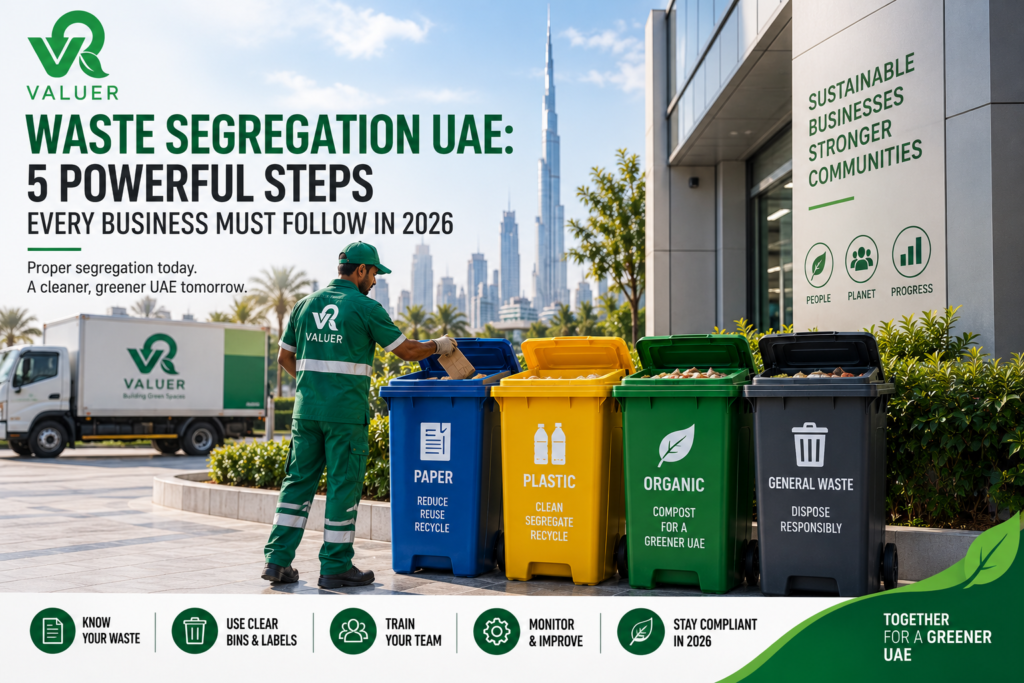
Waste segregation UAE compliance has moved from a regulatory aspiration to an actively enforced operational requirement for every commercial, industrial, and residential property across the country in 2026. Law No. 18 of 2024 codified mandatory source segregation across all commercial, industrial, and multi-residential premises in Dubai — and what began as a Dubai-specific framework is rapidly becoming the national standard as Abu Dhabi, Sharjah, and the federal environmental authorities align their enforcement frameworks with the same mandatory segregation principles.
The consequences of getting waste segregation UAE wrong are no longer theoretical. UAE climate change legislation penalties for non-compliance range from AED 50,000 to AED 2,000,000 DHL — a penalty range that makes waste segregation UAE a board-level compliance priority for any business operating across the country, not just a facilities management housekeeping task. This guide gives you the five most important steps for getting waste segregation UAE right from the ground up in 2026.
Why Waste Segregation UAE Enforcement Is Intensifying in 2026
Mandatory landfill-diversion targets anchored in national visions — including the UAE’s 75% recycling ambition — convert policy pressure into steady compliance enforcement pressure for commercial operators, with AI-assisted inspection tools at transfer stations and surprise site visits making waste segregation UAE non-compliance increasingly difficult to conceal and increasingly expensive when detected. Research And Markets
The commercial waste stream is where segregation enforcement is most actively focused — with commercial waste streams registering the highest 9.57% CAGR across the GCC waste management market, Mordor Intelligence reflecting both the volume growth of commercial waste and the regulatory intensity being directed at commercial operators who generate it. For any business operating across the UAE in 2026, waste segregation UAE compliance is both a legal obligation and an increasingly measurable commercial advantage.
Step 1 — Understand the UAE’s Mandatory Colour-Coding System
The foundation of compliant waste segregation UAE practice is understanding and implementing Dubai Municipality’s mandatory colour-coding system across every waste generation point in your facility. Without correctly colour-coded containers positioned at every generation point, waste segregation UAE cannot function — because the colour is the communication tool that tells every person generating waste exactly which container receives each waste type.
The four primary colour designations in the waste segregation UAE framework are black for general municipal solid waste, yellow for dry recyclables including clean cardboard, paper, plastics, and aluminium cans, green or brown for organic and food waste, and red for hazardous materials including chemicals, batteries, and clinical waste. Valuer UAE’s plastic refuse bins are available across all four required colour designations — enabling businesses to implement a fully compliant colour-coded waste segregation UAE system across every area of their facility from a single supplier.
Step 2 — Position Containers at Every Generation Point
The second most common waste segregation UAE failure — after incorrect colour coding — is inadequate container coverage across the facility. A business that implements waste segregation UAE correctly in the main refuse room but fails to provide segregated containers at individual floor offices, kitchen preparation areas, loading docks, and outdoor service areas will find that all the correct-colour containers in the world do not prevent contamination when no segregated option is available at the actual point of waste generation.
Every area of your facility where waste is generated needs appropriately colour-coded, correctly sized containers matched to the waste type generated there. A kitchen needs sealed organic waste bins positioned at food preparation and food waste generation points — not just in the back-of-house refuse room. An office floor needs clearly labelled yellow recycling bins at printer and paper consumption points — not just in the general office waste area. The litter bins positioned across public-facing areas of commercial properties need to support the same segregation standards as back-of-house infrastructure — with dual-stream public litter bins increasingly standard across UAE commercial developments.
Step 3 — Train Every Staff Member Who Generates Waste
Waste segregation UAE compliance is a human behaviour problem as much as an infrastructure problem — and even the most comprehensively specified container system fails if the people using it do not understand what goes where and why it matters.
Every staff member who generates waste needs to understand the four colour designations, the specific waste types that belong in each stream relevant to their work area, and the consequences of contamination — both for the business’s compliance position and for the effectiveness of the recycling and recovery programmes that correct segregation enables. Waste stream mapping and staff training on correct waste segregation UAE practice is the foundation of the compliance posture that protects a business when an inspector arrives. Dubaiwaste
Training does not need to be complex — a 30-minute onboarding session for new staff, clear visual signage above every bin, and a quarterly reminder at team meetings is sufficient for most commercial operations to maintain strong waste segregation UAE compliance across their workforce.
Step 4 — Use Correctly Specified Containers for Each Stream
The physical specification of the containers you use across your waste segregation UAE system matters as much as their colour and positioning — with dome lid seals, load capacity, and collection truck compatibility all directly affecting whether your segregated waste streams actually make it through the collection process without becoming contaminated mixed waste.
For organic and food waste streams, sealed dome lid containers with rubber beading that prevents odour escape between collection cycles are essential — with Valuer UAE’s galvanized metallic bins providing the structural resilience and hygienic closure performance that high-volume organic waste streams in commercial kitchens and hospitality operations demand. For bulk waste streams in construction and industrial environments, correctly sized metallic skips with appropriate capacity matching the generation rate prevent the overflow that turns a compliant segregated system into a visible non-compliance failure between collection visits.
Step 5 — Document Everything and Demand Waste Transfer Notes
Documentation and Waste Transfer Notes for every collection are the proof of compliance that protects a business when an inspector asks questions — and missing paperwork is one of the leading causes of penalty notices across Dubai’s commercial sectors. Al Merzaam
A complete waste segregation UAE documentation system covers the waste stream audit results that established your current container configuration, Waste Transfer Notes from every licensed contractor collection across every stream, training records showing that staff have been instructed on waste segregation UAE requirements, and container maintenance records showing that infrastructure has been kept in serviceable condition.
This documentation does not just protect you during inspections — it creates the performance baseline from which you can identify where your waste segregation UAE programme is working, where contamination rates are highest, and where operational changes can reduce both waste disposal costs and compliance exposure simultaneously. According to Dubai Municipality, all commercial premises must maintain waste management documentation as part of their compliance obligations under Law No. 18 of 2024.
FAQs — Waste Segregation UAE
Is waste segregation UAE mandatory for all businesses?
Yes. Law No. 18 of 2024 mandates source segregation for all commercial, industrial, and multi-residential premises in Dubai — with equivalent requirements progressively being enforced across Abu Dhabi, Sharjah, and the wider UAE under federal environmental frameworks.
What colour bins are required for waste segregation UAE compliance?
Black for general waste, yellow for dry recyclables, green or brown for organic and food waste, and red for hazardous materials — all required by Dubai Municipality under the mandatory waste segregation UAE colour-coding framework.
What happens if a business fails waste segregation UAE compliance?
Penalties under UAE climate change legislation range from AED 50,000 to AED 2,000,000 for non-compliance — with contaminated loads at transfer stations also generating additional rejection fees and potential contractor relationship damage that compounds the total financial impact.
Where can I get correctly colour-coded bins for waste segregation UAE compliance?
Valuer UAE supplies plastic refuse bins, galvanized metallic bins, metallic skips, and litter bins across all required colour designations — covering the full range of container requirements for waste segregation UAE compliance across every industry sector.
How do I contact Valuer UAE about waste segregation UAE container supply?
Contact Valuer UAE via the enquiry form, email hello@valueruae.com, or WhatsApp +971 52 653 4567 for a fast, itemised container quote.