
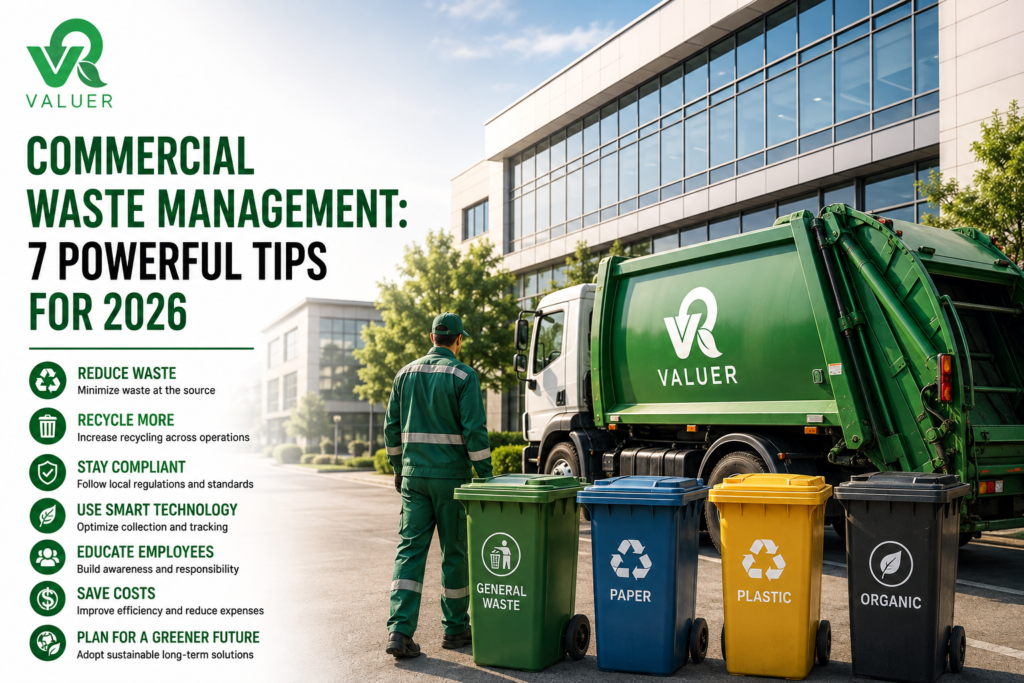
Commercial waste management is one of the most financially consequential operational responsibilities for any business across the UAE in 2026 — and one of the most commonly mishandled. The UAE industrial waste management market is valued at USD 4.36 billion in 2026 and growing at 6.61% CAGR through 2031 Research And Markets — a figure that reflects not just the scale of the waste generated across the region’s commercial and industrial sectors, but the growing regulatory infrastructure that is making non-compliant commercial waste management increasingly expensive for businesses that get it wrong.
Serious commercial and industrial operators in the UAE need more than waste collection — they need compliance confidence, recycling outcomes, operational transparency, and a partner that grows with their business. Dubaiwaste This guide gives you the 7 most impactful actions any business can take to improve its commercial waste management operation in 2026 — covering infrastructure, compliance, cost reduction, and long-term sustainability.
Why Commercial Waste Management Is a Priority Business Issue Right Now
The ESG landscape in the UAE is evolving rapidly, with 2026 marking a significant shift toward mandatory climate compliance, sustainability reporting, and responsible business practices — with companies that proactively integrate environmental management into their operations better positioned for regulatory compliance, investor confidence, and long-term business growth. Ehsconsultants
The financial stakes of poor commercial waste management have never been higher. UAE climate change legislation now active carries penalties for non-compliance ranging from AED 50,000 to AED 2,000,000 DHL — a penalty range that puts commercial waste management firmly in the category of financially material business risk rather than operational background noise. For any business operating across Dubai, Abu Dhabi, or Sharjah, getting commercial waste management right in 2026 is a strategic priority, not a housekeeping task.
Tip 1 — Conduct a Waste Stream Audit Before Buying Any Equipment
The most common and costly mistake businesses make when setting up commercial waste management infrastructure is buying bins and skips before they understand what waste their operation actually generates. A waste stream audit — mapping every material leaving your premises, identifying each waste type, approximate monthly volume, generation point, and storage requirements — is the foundation of a compliant and cost-efficient commercial waste management operation. Dubaiwaste
The audit output tells you exactly what combination of galvanized metallic bins, plastic refuse bins, and metallic skips your operation needs — eliminating the guesswork that leads businesses to purchase undersized containers that overflow between collections or oversized containers that waste money on unnecessary collection capacity.
Tip 2 — Match Container Specification to Each Waste Stream
Effective commercial waste management is built on the principle of segregation at source — meaning the right container must be positioned at each waste generation point across your operation, matched to the specific waste type generated there. A kitchen generating food waste needs sealed plastic refuse bins with colour coding that meets Dubai Municipality’s mandatory green or brown organic waste designation. A warehouse generating cardboard and packaging needs clearly labelled yellow-designated bins for dry recyclables. A construction site generating bulk mixed waste needs appropriately sized metallic skips positioned for efficient loading.
Poor waste management affects workplace hygiene, brand reputation, employee safety, and regulatory compliance — making container specification one of the most consequential infrastructure decisions in any commercial waste management programme. Sawmuae
Tip 3 — Size Containers to Actual Volume, Not Guesswork
One of the most reliably costly failures in commercial waste management is container sizing based on assumption rather than measured waste volume data from a completed stream audit. An undersized bin in a high-generation area overflows before collection day — creating hygiene failures, pest attraction, and the kind of visible non-compliance that triggers Dubai Municipality enforcement responses. An oversized bin generates unnecessary collection fees for empty capacity.
The correct container sizing decision for any commercial waste management operation uses three data points — daily average volume per stream, collection frequency available from your licensed contractor, and peak volume allowance for high-occupancy or high-production periods that temporarily exceed average daily generation. Galvanized metallic bins from Valuer UAE are available in 1.1 CBM, 2.5 CBM, and 4.5 CBM — covering the full range of volume requirements from small commercial properties through to large industrial facilities.
Tip 4 — Work Exclusively With Licensed Waste Contractors
This is non-negotiable. Every licensed contractor in the UAE’s commercial waste management system issues a Waste Transfer Note for every collection — the documentation that proves your waste was handled by an approved operator and disposed of through a compliant facility. Waste manifests are not administrative overhead — they are your proof of compliance if an inspection occurs, and missing paperwork is one of the leading causes of penalty notices in Dubai’s commercial sectors. Dubaiwaste
Working with unlicensed collectors to reduce commercial waste management costs eliminates the very documentation that protects your business during inspections — creating a false economy that costs multiples of any saving achieved when enforcement action follows.
Tip 5 — Implement Colour-Coded Segregation Across All Areas
Multi-compartment bins with clear labelling and colour coding for easy sorting are the standard specification for offices and commercial spaces requiring compliant waste segregation across multiple simultaneous streams. Micro Supply
Dubai Municipality’s mandatory colour-coding system requires black for general waste, yellow for dry recyclables, green or brown for organic waste, and red for hazardous materials. A commercial waste management programme that does not implement this colour coding consistently across every generation point in the facility creates contaminated waste streams that result in rejected loads — adding both cost and compliance exposure to an operation that was trying to reduce both.
Tip 6 — Schedule Regular Container Maintenance
Commercial waste management infrastructure does not run itself — and containers that are not maintained progressively become less effective as wheels seize, dome lid springs fail, and lifting pocket bolts corrode. A galvanized metallic bin in a high-use commercial refuse room is subject to continuous daily loading, cleaning chemical exposure, and the salt air corrosion that Dubai’s coastal environment accelerates across all steel surfaces. Quarterly wheel lubrication, dome lid spring inspection, and lifting pocket bolt re-torquing keeps every container in the commercial waste management fleet performing reliably and compatibly with municipality collection trucks across years of demanding daily use.
Tip 7 — Review Your Programme Quarterly
A manufacturing company in the UAE reduced waste disposal costs significantly after implementing structured environmental tracking — the change started with simply measuring where waste was being generated, something the company had never formally tracked before, and that single insight led to targeted reductions across three production lines. certifypowerhouse
The most effective commercial waste management programmes are not static — they are reviewed quarterly against key performance metrics including total waste volume per stream, contamination rates, collection frequency versus actual container fill cycles, and total monthly cost per kilogram of waste managed. Quarterly review consistently identifies optimisation opportunities — stream combinations that reduce collection trips, container relocations that improve segregation compliance rates, and contractor performance issues that need addressing before they create compliance exposure.
According to Dubai Municipality, all commercial premises must maintain appropriate waste management infrastructure and documentation — making structured, documented commercial waste management a legal compliance requirement as much as an operational best practice.
FAQs — Commercial Waste Management
What containers are required for commercial waste management in the UAE?
The specific containers required depend on your waste stream audit results — but most commercial operations across the UAE require a combination of galvanized metallic bins for general and bulk waste, colour-coded plastic refuse bins for segregated recyclable and organic streams, and metallic skips for sites generating high volumes of bulk or construction waste
How often should containers be collected in a commercial waste management programme?
Collection frequency should be matched to actual container fill cycles identified through waste stream audit — with daily collection required for food waste and organic streams in hospitality and food service operations, and less frequent collection appropriate for dry recyclable and general waste streams generating lower daily volumes.
What documentation is required for commercial waste management compliance in Dubai?
A Waste Transfer Note must be issued by your licensed waste contractor for every collection — documenting waste type, volume, collection date, contractor licence reference, and disposal facility. These records must be maintained and made available during Dubai Municipality inspections.
Can Valuer UAE supply containers for commercial waste management programmes?
Yes. Valuer UAE supplies galvanized metallic bins, plastic refuse bins, metallic skips, and litter bins across the UAE — covering the full range of container requirements for commercial waste management programmes across every industry sector and property type.
How do I contact Valuer UAE about commercial waste management container supply?
Contact Valuer UAE via the enquiry form, email hello@valueruae.com, or WhatsApp +971 52 653 4567 for a fast, itemised quote on any container requirement across the UAE.