
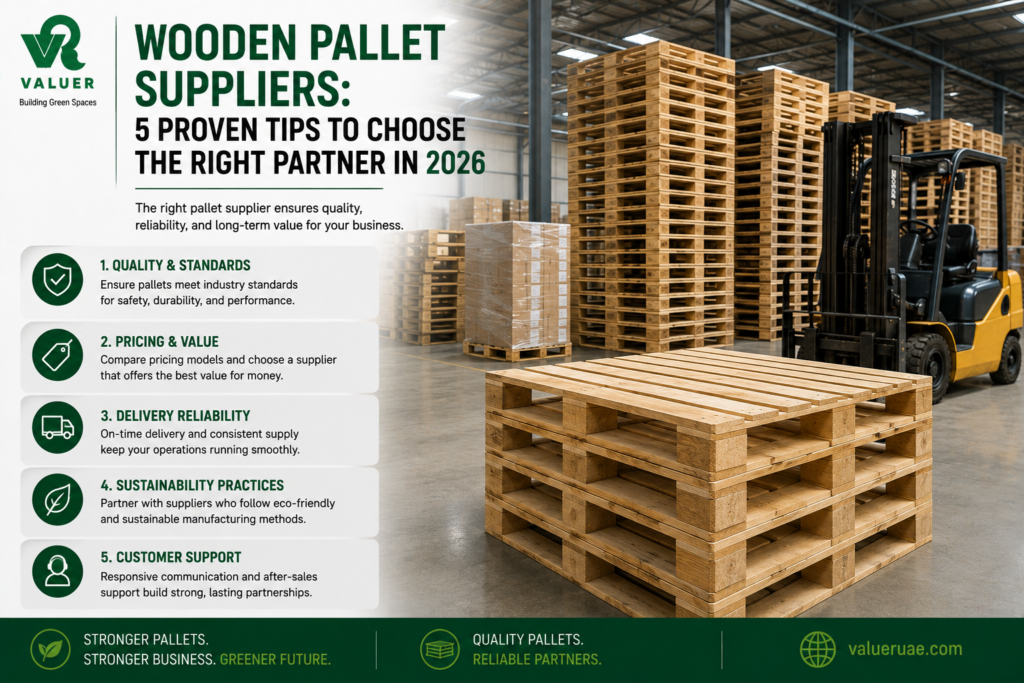
Wooden pallet suppliers vary enormously in quality, compliance, lead time reliability, and total cost transparency — and choosing the wrong supplier creates supply chain disruptions, export compliance failures, and total cost consequences that far exceed any savings achieved on headline unit pricing. In the UAE’s fast-paced logistics and distribution landscape, where warehouses in Jebel Ali, Dubai Logistics City, and Dubai Industrial City process goods on tight schedules with zero tolerance for packaging non-compliance, getting your wooden pallet suppliers right is one of the most operationally important procurement decisions a logistics, manufacturing, or distribution business can make.
At Valuer UAE, we supply wooden pallets across the UAE and Middle East — and in this guide, we share the 5 proven tips that separate reliable wooden pallet suppliers from those that look competitive at quotation stage but create problems at every stage of the supply chain thereafter.
Why Choosing the Right Wooden Pallet Suppliers Matters in 2026
The wooden pallet market across the UAE in 2026 is more diverse than it has ever been — with domestic manufacturers, regional importers, and international trading companies all competing for the same business. This diversity creates real quality variation that buyers need to navigate carefully.
The most common problems businesses encounter with poorly chosen wooden pallet suppliers are inconsistent dimensional tolerance causing automated handling failures, absent or fraudulent ISPM-15 certification causing export rejections, and misleading load capacity ratings causing structural failures under normal operational loading — all of which are avoidable through proper supplier verification before the first order is placed.
Tip 1 — Verify ISPM-15 Certification for Export Applications
The most important verification step when evaluating wooden pallet suppliers for any export application is confirming that the supplier holds genuine, current ISPM-15 heat treatment certification — not just a claim that their pallets are compliant.
ISPM-15 requires that wooden pallets used in international trade be heat-treated to a core temperature of 56 degrees Celsius for a minimum of 30 continuous minutes — eliminating wood-boring pests that could otherwise cross international borders within pallet timber. Wooden pallet suppliers who are genuinely ISPM-15 compliant will provide the official IPPC mark stamped on each pallet confirming the heat treatment facility registration number, treatment method, and country of origin.
Wooden pallet suppliers who cannot provide documented heat treatment facility registration details and per-batch treatment records should be considered non-compliant for international export applications — regardless of any verbal assurance they provide about their pallets’ export suitability.
Valuer UAE supplies ISPM-15 heat-treated wooden pallets with full compliance documentation for all export customers — ensuring that shipments clear international customs without delays, fines, or forced fumigation at destination ports.
Explore: Wooden Pallets — Valuer UAE
Tip 2 — Confirm Timber Grade and Dimensional Tolerance
The second most impactful differentiator between quality and poor wooden pallet suppliers is the consistency of timber grade and dimensional tolerance across each pallet batch — with both factors directly impacting automated warehouse handling performance, racking system compatibility, and safe load capacity.
Quality wooden pallet suppliers specify and document the timber species, moisture content, and grading standard used in each pallet’s construction — enabling buyers to verify that the pallets they receive consistently match the specification they ordered across every delivery. Poor wooden pallet suppliers substitute lower-grade timber without disclosure when supply constraints tighten — creating structural performance variation that only becomes apparent when pallet failures occur under normal operational loading.
For businesses running automated warehouse systems where pallets must pass through conveyor entry points within defined dimensional tolerances, this consistency is not a quality preference — it is an operational requirement that determines whether automated handling runs without jams or requires constant manual intervention.
Tip 3 — Evaluate Bulk Pricing Structure and Lead Time Reliability
The third critical factor when comparing wooden pallet suppliers is the transparency of their bulk pricing structure and their demonstrable reliability on lead time commitments — two factors that determine whether a supplier relationship creates operational certainty or uncertainty across the supply chain.
Quality wooden pallet suppliers provide itemised, tiered pricing documentation that shows exactly how per-unit cost changes across different order volume thresholds — enabling buyers to plan procurement accurately and model their true packaging cost at expected annual volumes. Wooden pallet suppliers who provide only vague directional pricing guidance without documented tier structures create procurement uncertainty that compounds across every order cycle.
Lead time reliability is equally important — particularly for businesses in the UAE’s construction, retail, and food distribution sectors where production schedules and delivery commitments to customers depend on packaging materials arriving as promised. Always request references from existing customers specifically on delivery reliability — not just product quality — before committing to any new wooden pallet supplier relationship.
Tip 4 — Assess Repair and Return Programme Availability
Quality wooden pallet suppliers offering repair and return programmes deliver measurably lower total packaging cost to buyers who run consistent domestic distribution operations — with repaired wooden pallets costing 40 to 60% of new pallet price while delivering equivalent structural performance for continued domestic use across standard warehousing and distribution applications.
Wooden pallet suppliers who offer repair and reconditioning programmes provide buyers with a total cost of ownership advantage that purely new-pallet suppliers cannot match — particularly relevant for businesses running high-volume domestic distribution operations where pallet return rates from retail or production outlets are predictable and managed.
For export operations, repaired pallets are generally not appropriate — ISPM-15 requirements apply to the full pallet structure including any replacement timber, and managing the compliance documentation for repaired pallets adds complexity that most export-focused businesses prefer to avoid by specifying new certified pallets throughout their export packaging programme.
Tip 5 — Confirm UAE-Wide Delivery Capability
The fifth and most practically important tip when evaluating wooden pallet suppliers for a UAE business is confirming genuine delivery capability across all the Emirates where your business operates — not just Dubai.
Many wooden pallet suppliers in the UAE market have strong delivery infrastructure within Dubai but significantly less reliable coverage for delivery to Abu Dhabi, Sharjah, Ras Al Khaimah, Fujairah, and Al Ain — creating delivery delays and additional logistics costs for businesses with multi-emirate operations that were not factored into the headline pricing comparison.
Valuer UAE delivers wooden pallets across Dubai, Sharjah, Abu Dhabi, and the wider UAE from a single procurement relationship — providing logistics, manufacturing, and distribution businesses with the multi-emirate coverage they need from a single, accountable wooden pallet supplier.
Explore: Wooden Pallets and Logistics Solutions — Valuer UAE
According to ESMA, packaging materials used in the UAE must comply with applicable safety and quality standards — Valuer UAE ensures all wooden pallet products meet relevant UAE and international compliance requirements.
FAQs — Wooden Pallet Suppliers
Do wooden pallet suppliers in the UAE provide ISPM-15 certified pallets?
Quality wooden pallet suppliers in the UAE provide ISPM-15 heat-treated pallets with documented treatment facility registration numbers and per-batch treatment records for international export applications. Always request and verify this documentation rather than relying on verbal assurances of export compliance.
What should I look for when evaluating wooden pallet suppliers in the UAE?
The five most important factors when evaluating wooden pallet suppliers are ISPM-15 certification for export applications, timber grade and dimensional tolerance consistency, bulk pricing transparency and lead time reliability, repair and return programme availability for domestic operations, and UAE-wide delivery capability across all Emirates where your business operates.
What wooden pallet sizes do wooden pallet suppliers in the UAE typically stock?
Most wooden pallet suppliers in the UAE stock standard sizes including the widely used 48 by 40 inch configuration and standard Euro pallet dimensions — with custom size options available from manufacturers who fabricate pallets to buyer specification for non-standard product packaging applications.
How do repaired wooden pallets compare to new pallets from wooden pallet suppliers?
Repaired wooden pallets from quality suppliers deliver equivalent structural performance for domestic distribution applications at 40 to 60% of new pallet cost — but are generally not appropriate for international export applications where ISPM-15 compliance across the full pallet structure including any replacement timber creates documentation complexity.
How do I get a quote from Valuer UAE as wooden pallet suppliers?
Contact Valuer UAE via our enquiry form, email hello@valueruae.com, or WhatsApp +971 52 653 4567 for a fast, itemised quote on wooden pallets across any volume and specification requirement.