
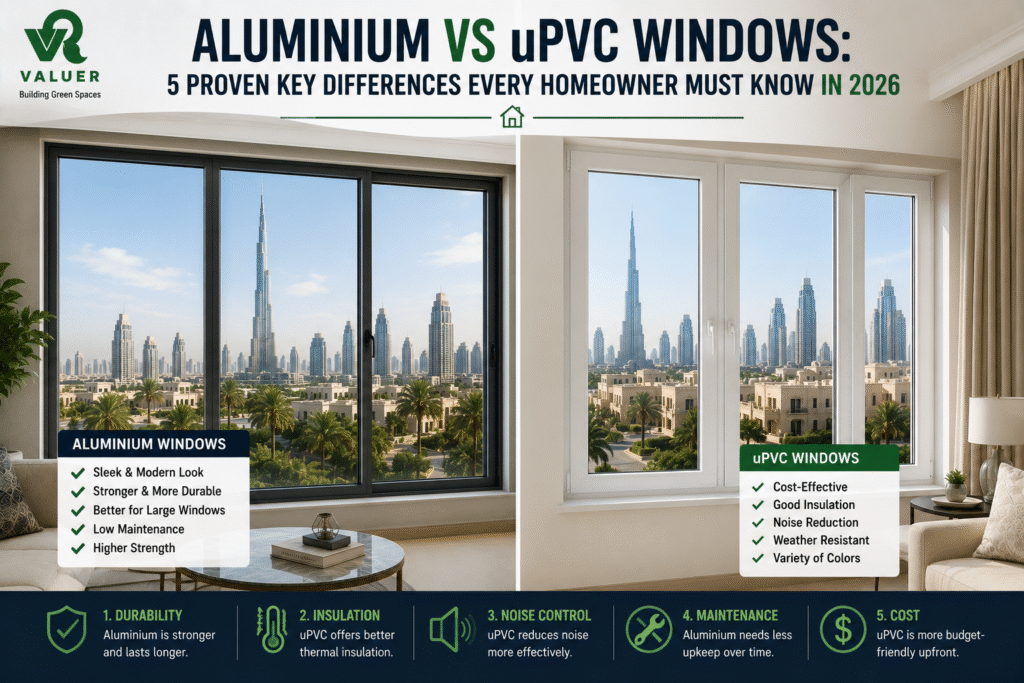
Aluminium vs uPVC windows — it is the most commonly asked window question among homeowners, developers, and commercial property managers across the UAE and beyond in 2026. Both materials are widely available. Both are offered by numerous suppliers. The price difference between them is real. The performance difference is equally real — and in the specific environmental conditions of the Gulf region, that performance gap matters more than it does almost anywhere else on the planet.
Both aluminium and uPVC can perform excellently across the UAE. The best one genuinely depends on your budget, the size of the openings, how exposed they are to direct sun, and what matters most to you — slim modern frames, lowest cost, or maximum insulation. Altaherdesign
At Valuer UAE, we design, fabricate, and install premium aluminium windows and doors across the UAE — and in this guide, we give you the honest, detailed breakdown of the aluminium vs uPVC windows comparison that you need to make the right decision for your specific property, budget, and performance requirements.
Why the Aluminium vs uPVC Windows Decision Matters More in the UAE Than Anywhere Else
Window material selection is more consequential in the UAE than in most markets globally — for three specific reasons that directly impact every homeowner and developer across the region.
Thermal break modern aluminium sliding windows can save up to 20 to 30% on air conditioning expenses — and in the UAE, where cooling costs make up a significant portion of electricity bills, this can easily add up to thousands of dirhams in annual savings across the lifetime of a window installation. Space Makeover
Dubai’s Al Sa’fat green building regulations now mandate specific energy performance standards for building envelopes — meaning the window system you choose must meet a defined thermal performance threshold, not just look good or fit your budget. The wrong material choice at specification stage creates long-term energy cost penalties and potential compliance failures that cost significantly more to correct than the original specification decision.
In coastal UAE locations, UV degradation is accelerated — making material selection for windows a more consequential long-term investment than in temperate climate markets where UV and temperature extremes are significantly less severe. Diamond Step
Difference 1 — Structural Strength and Frame Performance
Aluminium wins clearly on structural strength. Aluminium is a metal — it expands and contracts predictably with temperature changes and always returns to its original dimensions — making it the definitive choice for large villa windows, high-rise glazing, and coastal properties where structural strength matters most. Diamond Step
Aluminium wins on structural strength, appearance, and large spans — by contrast, uPVC provides stronger natural insulation at a lower initial price, with its thicker frame reducing the visible glass area compared to equivalent aluminium profiles. ZAH Technical Studio
The practical consequence of this strength difference is significant for UAE properties. Large-span window openings — floor-to-ceiling glazing, wide sliding door systems, and large fixed panels that define modern UAE villa and apartment design — require the structural capability that aluminium provides. uPVC profiles at equivalent glass span widths require significantly deeper and more visible frame sections to achieve the same structural performance, compromising the slim, open aesthetic that defines contemporary UAE interior design.
Aluminium allows much slimmer frame profiles than uPVC — a thermally broken aluminium window can have a frame face width of 50 to 70mm, enabling slim-profile systems as thin as 15 to 20mm that maximise the amount of glass and natural light reaching every room. Space Makeover
Verdict: Aluminium wins on structural strength, large-span capability, and slim profile aesthetics. uPVC suits smaller standard opening sizes where structural demands are lower.
Difference 2 — Thermal and Energy Performance
This is the dimension of the aluminium vs uPVC windows comparison where the most misconceptions exist — and where the correct specification decision delivers the most measurable financial and comfort impact across UAE properties.
Standard aluminium without thermal break transfers heat quickly through the frame — making un-broken aluminium profiles a poor energy performer in the UAE’s extreme climate. However, thermally broken aluminium — where a polymer insert separates the inner and outer aluminium frame sections — eliminates this heat transfer pathway and delivers thermal performance that matches or exceeds standard uPVC across most real-world UAE applications.
Thermally broken aluminium is more durable for intense UV and large openings with slimmer frames — uPVC provides slightly better raw insulation at a lower initial price. The right pick depends on budget, window size, and sun exposure. Altaherdesign
Aluminium windows are highly resistant to heat, humidity, and sand — performing exceptionally well in extreme weather. uPVC can handle heat but may expand or lose shape over time — with UV degradation in coastal UAE locations accelerating the material’s dimensional instability and colour degradation significantly faster than in temperate markets. Al Alam Al Thahabi
When combined with double glazing and Low-E coating — which is the correct specification for any new window installation across the UAE in 2026 — thermally broken aluminium delivers excellent energy performance that satisfies Al Sa’fat green building requirements while providing the structural and aesthetic advantages that uPVC cannot match.
Verdict: Thermally broken aluminium with double glazing delivers the best overall energy and comfort performance for UAE properties. Standard uPVC has a slight raw insulation advantage that evaporates once thermal break aluminium is correctly specified.
Difference 3 — Durability and Lifespan in the UAE Climate
A good quality aluminium window frame will last 30 to 40 years with little maintenance — making it a cost-effective option over time that delivers significantly better total ownership value than uPVC alternatives across the UAE’s extreme climate conditions. Space Makeover
Aluminium requires minimal maintenance — occasional cleaning is enough to keep frames in good condition. uPVC is also low maintenance, but may discolour over time if exposed to harsh sunlight for long periods — with both materials performing better than timber in UAE conditions, but aluminium consistently outperforming uPVC over extended ownership periods. Al Alam Al Thahabi
The durability gap between aluminium and uPVC is most pronounced in the UAE’s specific combination of extreme heat, intense UV radiation, coastal salt air, and fine sand. uPVC profiles exposed to sustained temperatures above 60 degrees Celsius — a regular occurrence on south and west-facing walls during UAE summers — experience thermal expansion that stresses window seals, track systems, and hardware connections over time. Aluminium’s higher melting point and predictable thermal expansion characteristics make it significantly more dimensionally stable across the temperature ranges common in UAE outdoor window exposure.
Well-made aluminium systems will last 30 to 50 years with routine cleaning and hardware maintenance — making aluminium the preferred choice for large villa windows, high-rise glazing, and coastal properties where strength and longevity matter most. ZAH Technical Studio
Verdict: Aluminium wins on long-term durability and lifespan across UAE conditions — particularly in coastal, south-facing, and high-temperature exposure locations.
Difference 4 — Cost — Upfront vs Total Ownership
Aluminium is usually more expensive due to its durability, strength, and premium finish. uPVC is more budget-friendly and ideal for cost-conscious homeowners — but both materials deliver low maintenance requirements that keep ongoing costs manageable across most residential applications. Al Alam Al Thahabi
In the UAE market, aluminium window pricing for standard residential configurations typically ranges from AED 400 to AED 900 per square metre supply and install depending on profile system, thermal break specification, glass type, and hardware. uPVC window pricing typically ranges from AED 250 to AED 550 per square metre for comparable residential configurations — making uPVC’s upfront cost advantage approximately 30 to 40% lower than equivalent aluminium specifications.
However, when total ownership cost is evaluated across a realistic 20 to 30 year window lifespan, aluminium’s longer operational life, lower maintenance requirements, and retained structural performance consistently deliver lower cost per operational year than uPVC alternatives — particularly in UAE coastal and high-UV-exposure locations where uPVC colour degradation and dimensional instability require earlier intervention and replacement.
For commercial properties and large residential developments where window replacement across an entire building involves significant mobilisation and disruption costs, the extended lifespan of aluminium windows delivers an additional total cost advantage over uPVC that amplifies the lifecycle cost comparison further in aluminium’s favour.
Verdict: uPVC wins on upfront cost. Aluminium wins on total ownership cost across a realistic 20 to 30 year window lifespan in UAE conditions.
Difference 5 — Aesthetics, Design Flexibility, and Colour Options
Aluminium offers a sleek, modern, and premium look — with slim frames allowing for larger glass areas, giving a clean and elegant finish. uPVC is generally bulkier in appearance and available in limited design options compared to aluminium — making aluminium the preferred aesthetic choice across contemporary UAE villa, apartment, and commercial design. Al Alam Al Thahabi
The design flexibility gap between aluminium and uPVC is significant in the UAE context — where modern architectural language, large glass spans, and precision finish quality are expectations rather than preferences across the premium residential and commercial property sectors. Aluminium’s compatibility with powder coating in any RAL colour, wood-grain sublimation finishes, anodized metallic effects, and premium hardware in brushed gold, matte black, and satin chrome gives specifiers and homeowners an essentially unlimited design palette. uPVC’s colour and finish range is significantly more constrained — with white, cream, and a limited range of foil-wrapped wood-effect options dominating most uPVC supplier catalogues in the UAE market.
Dark uPVC finishes absorb more solar heat than equivalent aluminium powder-coated profiles — so profile quality and foil suitability will matter in exposed UAE locations. Before approving a colour for uPVC, always request a physical sample and confirm exterior-grade warranty and community guideline compliance. ZAH Technical Studio
Verdict: Aluminium wins decisively on design flexibility, colour range, aesthetic quality, and compatibility with UAE architectural trends.
Aluminium vs uPVC Windows — The Complete Summary
| Factor | Aluminium Windows | uPVC Windows |
|---|---|---|
| Structural strength | Superior — handles large spans and slim profiles | Good — suitable for standard residential openings |
| Thermal performance | Excellent with thermal break and double glazing | Good — slight raw insulation advantage without thermal break |
| Durability in UAE | 30 to 50 years — excellent in extreme conditions | 15 to 25 years — UV and heat degradation faster in Gulf climate |
| Upfront cost | Higher — premium material and finish | Lower — 30 to 40% less upfront than aluminium |
| Total ownership cost | Lower — longer lifespan and minimal maintenance | Higher — earlier replacement in UAE conditions |
| Design flexibility | Unlimited — any RAL colour, slim profiles, premium hardware | Limited — constrained colour range and bulkier profiles |
| Best for UAE | Strongly recommended across all property types | Suitable for budget-constrained residential projects with smaller standard openings |
Which Should You Choose?
Choose aluminium windows if your property has large glass openings, if you are in a coastal or high-UV-exposure location, if contemporary slim-frame aesthetics are important to your design, if energy efficiency and Al Sa’fat compliance are priorities, or if you want a 30 to 50 year window solution that holds its appearance and performance with minimal intervention.
Choose uPVC windows if your budget is constrained and you need the lowest possible upfront cost, if your openings are standard residential sizes that do not require the structural depth of aluminium, and if you are prepared for earlier replacement and potential colour degradation in high-UV-exposure UAE locations.
At Valuer UAE, we fabricate and install premium aluminium windows across the UAE — guiding every client through the right specification for their specific property, location, and budget. According to Dubai Municipality, all window installations must comply with applicable UAE building codes and Al Sa’fat energy performance standards. Valuer UAE manages full compliance on every installation.
Explore our aluminium window range: Aluminium Windows — Valuer UAE
Frequently Asked Questions — Aluminium vs uPVC Windows
Are aluminium windows better than uPVC for UAE homes?
For most UAE residential and commercial properties — particularly in coastal communities and any property with large glass openings — aluminium windows deliver better structural performance, longer lifespan, superior design flexibility, and lower total ownership cost than uPVC alternatives across the Gulf’s extreme climate conditions.
Which is cheaper — aluminium or uPVC windows?
uPVC windows are 30 to 40% lower in upfront material and installation cost than equivalent aluminium systems. However, aluminium’s longer lifespan of 30 to 50 years versus uPVC’s 15 to 25 years in UAE conditions means aluminium delivers lower cost per operational year across a realistic ownership timeline.
Do aluminium windows require a thermal break in the UAE?
Yes. Standard aluminium without thermal break transfers heat quickly through the frame — making thermally broken aluminium the correct specification for any residential or commercial window installation across the UAE’s extreme climate. Thermal break combined with double glazing can reduce air conditioning costs by 20 to 30%.
Can uPVC windows handle the UAE’s extreme heat?
uPVC handles heat but may expand or lose dimensional stability over time in sustained high-temperature exposure — with UV degradation accelerating colour fading and material performance decline in UAE coastal and south-facing locations significantly faster than in temperate climate markets.
Where can I get aluminium windows installed across the UAE?
Contact Valuer UAE via our enquiry form, email hello@valueruae.com, or WhatsApp +971 52 653 4567 for a fast, itemised quote on aluminium window supply and installation across Dubai, Sharjah, Abu Dhabi, and the wider UAE.