
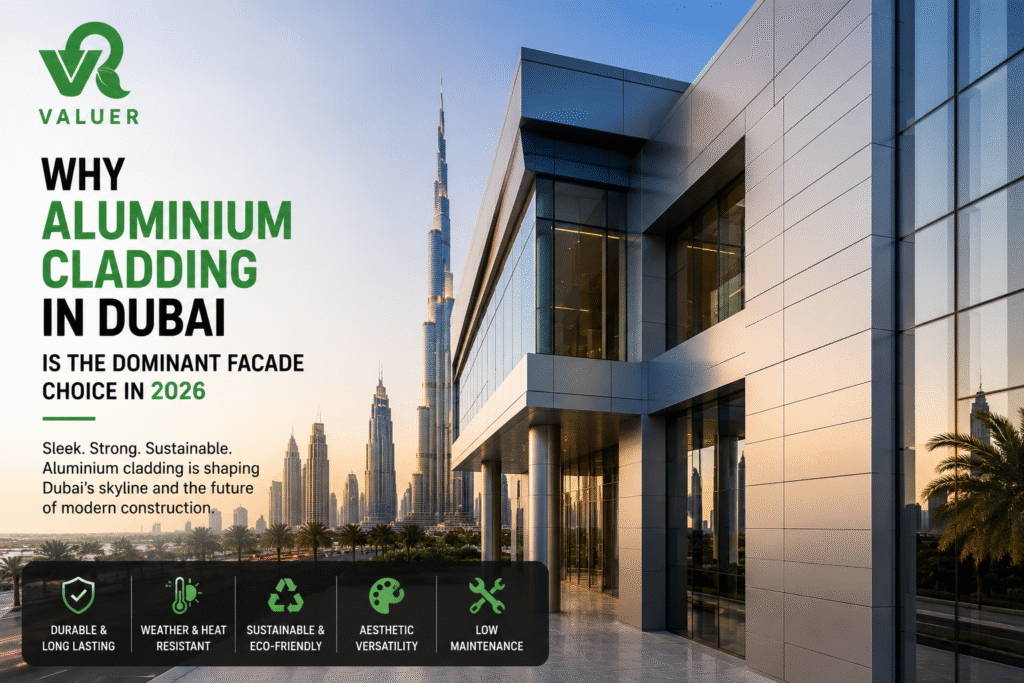
Aluminium cladding in Dubai is one of the most critical and fastest-growing exterior building material categories across the UAE’s residential, commercial, industrial, and hospitality construction sectors in 2026. Walk through any commercial district in Dubai — Al Quoz, Deira, Business Bay, or Jebel Ali Free Zone — and count the buildings with clean, modern aluminium facade systems — you will run out of time before you run out of buildings. The global architectural aluminium cladding market is projected to grow at a CAGR of 2.6% from 2026 to 2032, reaching USD 7.44 billion by the end of the forecast period — with the Middle East and UAE among the fastest-growing regional markets driven by rapid urbanisation, infrastructure expansion, and a strong demand for energy-efficient, fire-compliant building materials.
At Valuer UAE, we supply and install a comprehensive range of aluminium cladding in Dubai — including ACP panels, solid aluminium cladding, perforated screens, and architectural facade systems — for commercial towers, retail developments, hospitality properties, residential villas, and industrial facilities across the UAE and Middle East. In this guide, we cover the 5 proven essential types of aluminium cladding in Dubai and everything you need to know before specifying your project in 2026.
Why Aluminium Cladding in Dubai Is the Dominant Facade Choice in 2026
The dominance of aluminium cladding in Dubai across the UAE’s construction market is not accidental — it is the result of aluminium consistently outperforming every alternative facade material across the specific set of environmental, structural, and regulatory demands that Dubai’s built environment places on every building exterior.
Dubai’s extreme climate conditions — high temperatures, humidity, intense UV radiation, and occasional sandstorms — require advanced facade engineering to ensure building performance, with aluminium cladding in Dubai specifically engineered to deliver luxury aesthetics, energy efficiency, durability, and architectural flexibility simultaneously. Green building certifications including LEED and BREEAM are now standard requirements for 40% of new commercial projects worldwide, and aluminium’s 100% recyclability and low carbon footprint make it the material of choice for eco-conscious developers pursuing certification across Dubai’s competitive commercial property market.
Following high-profile building fires internationally — most notably the 2017 Grenfell Tower fire in London, which used non-compliant combustible cladding — Dubai Municipality and UAE Civil Defence significantly tightened facade fire safety requirements, making fire-resistant core aluminium cladding in Dubai a compliance requirement rather than an optional upgrade for most commercial and multi-storey applications across the emirate.
1. Aluminium Composite Panel Cladding in Dubai
Aluminium composite panel — widely known as ACP — is the most widely installed type of aluminium cladding in Dubai across the emirate’s commercial, retail, and industrial building sectors. ACP cladding in Dubai consists of two thin aluminium sheets bonded to a core material, offering a lightweight yet rigid panel system that delivers a sleek, modern facade finish across virtually any building type at a competitive cost per square metre compared to solid alternatives.
Supply and install pricing for fire-resistant core ACP with PVDF coating, including sub-frame, typically ranges from AED 180 to AED 400 per square metre depending on panel size, design complexity, and access requirements — making ACP aluminium cladding in Dubai one of the most cost-effective premium facade solutions available across the UAE market. AL BASIRA
The most critical specification decision when procuring ACP aluminium cladding in Dubai is choosing between PE core and FR core panels. For most commercial and mid-rise applications, FR core is the required specification under UAE Fire and Life Safety Code and Dubai Municipality building regulations — not an optional upgrade. FR core ACP contains a mineral compound that significantly suppresses combustion — making it the only legally compliant choice for most commercial aluminium cladding in Dubai projects. AL BASIRA
Key applications of ACP aluminium cladding in Dubai:
- Commercial office tower facades across Business Bay, DIFC, and JLT
- Retail shopping centre and mall exterior cladding and fascia systems
- Industrial warehouse and logistics facility exterior wall cladding
- Signage cladding, column covers, and decorative architectural finishes
- Villa exterior refurbishments seeking a modern, low-maintenance facade update
- Healthcare, educational, and government building facade systems
2. Solid Aluminium Panel Cladding in Dubai
Solid aluminium panel cladding in Dubai is the premium alternative to ACP — offering superior structural rigidity, deeper three-dimensional facade detail, and the highest level of long-term performance for demanding commercial, hospitality, and luxury residential facade applications across the emirate. Solid aluminium cladding in Dubai is available in custom-pressed, CNC-machined, and flat sheet configurations — with PVDF fluorocarbon coating ensuring 15-year weather resistance and colour stability across Dubai’s intense UV and heat conditions.
The global architectural aluminium cladding market’s fastest growth is coming from the Middle East, where rapid urbanisation and infrastructure development are driving demand for high-quality aluminium cladding solutions — with solid aluminium panel cladding in Dubai increasingly specified for landmark commercial towers, luxury hotel developments, and premium residential projects where ACP’s composite construction is considered insufficient for the project’s quality and longevity requirements.
Key benefits of solid aluminium panel cladding in Dubai:
- Superior structural rigidity — no risk of core delamination in Dubai’s extreme temperature cycles
- Compatible with complex curved, folded, and three-dimensional facade geometries
- PVDF coating with 15-year colour and gloss retention warranty for exterior applications
- 100% non-combustible — exceeds even FR core ACP in fire performance classification
- Available in any custom colour, texture, and surface finish specification
- Ideal for luxury hotel facades, high-rise commercial towers, and premium residential developments
3. Perforated Aluminium Cladding in Dubai
Perforated aluminium cladding in Dubai is one of the most architecturally distinctive and functionally sophisticated facade system categories — combining visual impact with genuine building performance benefits including solar shading, natural ventilation, and privacy screening across commercial, government, and hospitality building facades.
Perforated cladding systems are popular in government and commercial buildings for sun control and ventilation — with perforated aluminium cladding in Dubai now widely specified across schools, hospitals, government buildings, and commercial offices where reducing solar heat gain is as important as delivering an architecturally striking facade identity. Aluminium mesh facades are breathable, textured cladding for building exteriors blending ventilation, light control, and modern aesthetics in architectural design — making perforated aluminium cladding in Dubai one of the most multi-functional facade solutions available across the UAE market. Al Banan Group
Key applications of perforated aluminium cladding in Dubai:
- Solar shading and sun control screens for west-facing and high-exposure commercial facades
- Privacy and screening panels for residential balconies and villa boundary walls
- Ventilated rainscreen facade systems for commercial and industrial buildings
- Decorative perforated panel systems creating branded or geometric patterns across building facades
- Rooftop plant room enclosures and MEP equipment screening across commercial towers
- Car park facade systems allowing ventilation while maintaining visual screening from the street
4. Aluminium Curtain Wall Cladding in Dubai
Aluminium curtain wall cladding in Dubai represents the most technically complex and highest-value category of facade system across the emirate’s commercial construction market — with glass and aluminium curtain wall systems now defining the visual identity of Dubai’s commercial skyline across every major business district.
Glass curtain walls are commonly used in high-rise commercial towers across Dubai and Abu Dhabi to create visually impressive modern skylines — with aluminium curtain wall cladding in Dubai combining structural aluminium mullion and transom systems with high-performance glazing to deliver facade systems that are simultaneously load-bearing, weatherproof, thermally efficient, and architecturally distinguished. Aluminium curtain wall cladding in Dubai is used in airports and commercial towers to enhance both energy efficiency and modern architectural identity — making it the dominant facade specification for any commercial project above six storeys across the emirate. Al Banan Group
Key specifications for aluminium curtain wall cladding in Dubai:
- Stick-built curtain wall systems for medium-scale commercial and residential towers
- Unitised curtain wall systems — pre-fabricated off-site for large-scale commercial and airport projects
- Structurally glazed systems creating a frameless all-glass appearance for premium commercial facades
- Thermally broken aluminium profiles for Al Sa’fat green building energy performance compliance
- Compatible with tinted, reflective, Low-E, and solar control glazing for Dubai’s climate
- Full structural engineering for Dubai’s wind load requirements of 120 kilometres per hour or more
5. Architectural Decorative Aluminium Cladding in Dubai
Architectural decorative aluminium cladding in Dubai is the most design-intensive category — encompassing CNC-machined panels, mashrabiya-inspired perforated screens, corrugated and wave-profile aluminium panels, and custom-fabricated architectural elements that transform building exteriors into distinctive visual landmarks across Dubai’s competitive commercial and hospitality property landscape.
Hidden corrugated aluminium panels feature concealed fastening, seamless wave design, PVDF coating, and are lightweight and fireproof — ideal for office, commercial, and hotel facades — with double-curved aluminium veneer column cladding adopting five-axis CNC and three-dimensional hot-press forming with tolerance to plus or minus 2mm for metro stations, hotels, shopping malls, and office buildings. Nano self-cleaning PVDF coatings represent one of the most significant material innovations in architectural decorative aluminium cladding in Dubai in 2026 — reducing facade maintenance frequency and cost significantly across Dubai’s dust-heavy outdoor environment.
Key applications of architectural decorative aluminium cladding in Dubai:
- CNC laser-cut decorative facade screens for hotels, mosques, and government buildings
- Corrugated and wave-profile aluminium panels for contemporary commercial and hospitality facades
- Custom-bent and three-dimensionally formed aluminium cladding for curved architectural elements
- Column covers and entrance feature cladding for luxury hotel and commercial lobby applications
- Branded and patterned aluminium facade panels integrating corporate identity into building exteriors
- Nano self-cleaning PVDF-coated panels reducing maintenance costs across exposed commercial facades
According to Dubai Municipality, all aluminium cladding in Dubai involving permanent facade installations must comply with applicable building codes, UAE Fire and Life Safety Code fire performance standards, and DEWA energy efficiency requirements — with facade specifications reviewed as part of the building permit process requiring panel test certificates, fire performance documentation, and contractor approvals before installation commences. Valuer UAE manages the full compliance and permit process on every aluminium cladding in Dubai project.
Aluminium Cladding in Dubai — Critical Installation Requirements for 2026
Beyond material selection, the installation quality of aluminium cladding in Dubai is the single most important factor determining long-term facade performance across Dubai’s demanding environment.
Sub-frame design must account for UAE thermal movement — aluminium expands and contracts significantly between winter and summer, and joints must be designed to accommodate this movement without buckling or gap opening. Fixings must be stainless steel or equivalent corrosion-resistant material, since galvanised steel fixings corrode rapidly in coastal UAE conditions. Silicone sealant at joints must be UAE-climate-rated — standard silicone degrades under intense UV exposure within just a few years of installation. Panel edges should be factory-folded or properly sealed on site, since raw cut edges without sealant create corrosion initiation points that spread under the PVDF coating over time.
Always select a provider of aluminium cladding in Dubai who provides full panel test certificates, fire performance documentation to BS EN 13501 or equivalent UAE standards, and certified contractor documentation required for Dubai Municipality building permit approval — since aluminium cladding in Dubai where these credentials cannot be produced has not passed the compliance bar regardless of how the panels appear from street level.
Why Choose Valuer UAE for Aluminium Cladding in Dubai?
As a trusted supplier and installer of aluminium cladding in Dubai, Valuer UAE brings over 10 years of aluminium fabrication and technical services experience to every project. Our aluminium cladding in Dubai installations are trusted by commercial developers, property managers, construction contractors, hospitality groups, and industrial facility operators across the UAE and Middle East.
Here is why clients consistently choose Valuer UAE for aluminium cladding in Dubai:
- Full range of aluminium cladding in Dubai — ACP, solid aluminium, perforated, curtain wall, and architectural decorative options
- Fire-resistant FR core and non-combustible solid aluminium panels for full Dubai Municipality compliance
- PVDF and polyester powder-coated finishes in any custom colour and texture specification
- Full structural engineering documentation and Dubai Municipality permit management
- Fast, professional installation across Dubai, Sharjah, and Abu Dhabi
- Transparent, itemised pricing with no hidden costs
- Over 10 years of aluminium cladding design, fabrication, and installation experience
Explore our full range: Aluminium Cladding in Dubai — Valuer UAE
Frequently Asked Questions About Aluminium Cladding in Dubai
What types of aluminium cladding in Dubai does Valuer UAE supply and install?
Valuer UAE supplies and installs ACP panels, solid aluminium panels, perforated aluminium screens, curtain wall systems, and architectural decorative aluminium cladding in Dubai for commercial towers, retail developments, hospitality properties, residential villas, and industrial facilities across the UAE
Is fire-resistant core ACP required for aluminium cladding in Dubai?
Yes. Dubai Municipality and UAE Fire and Life Safety Code mandate fire-resistant FR core ACP for most commercial and multi-storey aluminium cladding in Dubai applications — making FR core the required specification, not an optional upgrade, for any commercial or mid-rise project.
How much does aluminium cladding in Dubai cost?
ACP aluminium cladding in Dubai with FR core and PVDF coating, including sub-frame and installation, typically ranges from AED 180 to AED 400 per square metre depending on panel size, design complexity, and site access requirements.
Does aluminium cladding in Dubai require Dubai Municipality approval?
Yes. All aluminium cladding in Dubai facade installations require building permit approval from Dubai Municipality — with facade specifications reviewed against UAE fire performance and energy efficiency standards before installation commences. Valuer UAE manages the full approval process.
How do I get a quote for aluminium cladding in Dubai from Valuer UAE?
Contact Valuer UAE via our enquiry form, email hello@valueruae.com, or WhatsApp +971 52 653 4567 for a fast, itemised quote on aluminium cladding in Dubai.